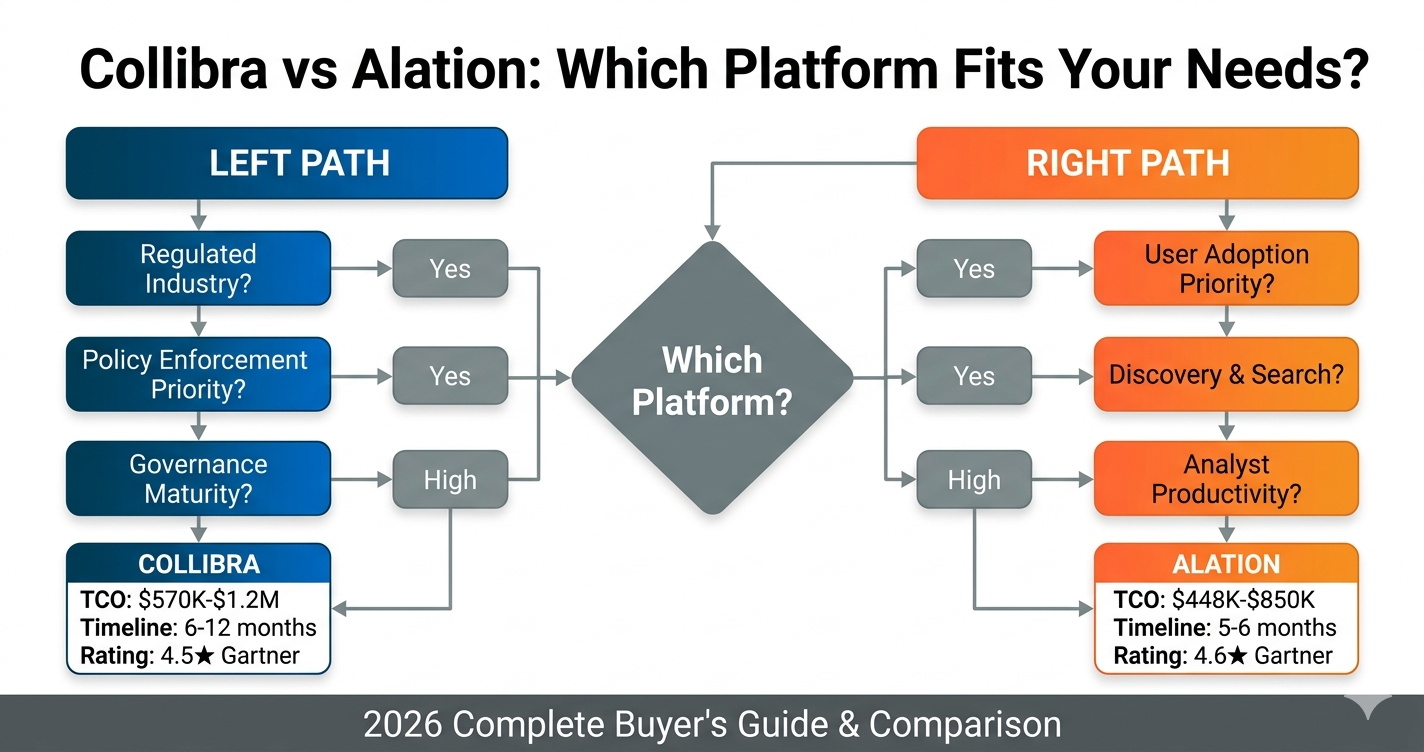
Complete 2026 platform comparison: Collibra governance-first approach vs Alation discovery-first approach, including TCO analysis ($570K-$1.2M vs $448K-$850K), implementation timelines (6-12 months vs 5-6 months), and Gartner Peer Insights ratings (4.5★ vs 4.6★).
Choosing between Collibra vs Alation ranks among the most consequential technology decisions data-driven organizations make. Both platforms dominate the enterprise data catalog and governance market, yet they approach data intelligence from fundamentally different philosophies. Collibra emphasizes governance rigor and policy enforcement for regulated industries. Alation prioritizes user adoption and collaborative data discovery.
This comprehensive comparison evaluates Collibra and Alation across architecture, features, implementation timelines, total cost of ownership, and real-world performance. You’ll learn which platform fits organizations
requiring comprehensive compliance frameworks, which serves teams needing rapid analyst adoption, and when neither legacy platform meets modern cloud-native requirements.
The stakes are high. Gartner’s 2026 Magic Quadrant for Data and Analytics Governance Platforms now names Leaders: Collibra, Alation, Informatica, and Atlan, signaling a maturing market where platform selection determines governance program success or failure. Organizations investing $170,000-$500,000 annually in these platforms must choose correctly the first time.
This analysis is written for data governance directors evaluating platform options, enterprise architects assessing technical fit, procurement teams comparing total cost of ownership, implementation leads planning deployment timelines, and executives approving governance platform investments. You’ll gain practitioner perspective on what these platforms actually deliver versus marketing promises.
This isn’t vendor marketing disguised as comparison content. This is an unbiased assessment from someone who has worked with both platforms in enterprise deployments, understands their technical architectures, and recognizes where each excels and fails.
- Understanding the Fundamental Difference: Governance vs Discovery
- Platform Architecture and Technical Foundation
- Feature Comparison: Governance vs Discovery Capabilities
- Implementation Timeline and Complexity
- Total Cost of Ownership Analysis
- User Experience and Adoption
- When to Choose Collibra
- When to Choose Alation
- Real-World User Feedback and Reviews
- Modern Alternatives Worth Considering
- Making the Decision: Evaluation Framework
- Frequently Asked Questions
- Summary
Understanding the Fundamental Difference: Governance vs Discovery
The core distinction between Collibra and Alation stems from their founding philosophies and target use cases.
Collibra: Governance-First Platform
Collibra provides a structured data governance framework with data stewardship, data definitions, and data lineage features, ensuring that data is well-defined and properly managed. The platform emerged in 2008 targeting highly regulated industries requiring comprehensive governance frameworks.
Collibra’s architecture reflects top-down governance thinking. Policies drive workflows. Workflows enforce compliance. Compliance generates audit trails. The platform excels when organizations need governance rigor justifying extended implementation timelines.
Collibra treats data governance as a discipline requiring formal processes, defined roles, policy enforcement mechanisms, and compliance documentation. The platform provides workflow automation ensuring stewards review changes, data owners approve access, and policies propagate across assets.
This governance-first approach delivers value when regulatory compliance is non-negotiable, audit trails are mandatory, policy violations carry financial penalties, and governance maturity is advanced.
Alation: Discovery-First Platform
Alation is a data catalog and data intelligence platform founded in 2012. The company’s flagship data catalog software uses AI, machine learning, automation, and natural language processing techniques to simplify data discovery. Alation pioneered the modern data catalog by making data discoverable before governable.
Alation’s architecture reflects bottom-up adoption thinking. Users search data. Search drives discovery. Discovery encourages curation. Curation improves governance organically. The platform excels when analyst productivity and self-service analytics are primary goals.
Alation encourages data collaboration by allowing users to leave annotations, comments, and ratings on data assets, creating a community-driven approach to data governance. The platform treats governance as an outcome of good user experience rather than a prerequisite.
This discovery-first approach delivers value when user adoption is the primary challenge, analysts need self-service data access, data culture emphasizes collaboration, and governance formality can develop gradually.
The Trade-Off You’re Actually Making
Choosing between Collibra and Alation means choosing between governance comprehensiveness and user adoption speed. Choose Collibra if governance, policy modeling and auditability are mission-critical and justify a longer implementation. Choose Alation when adoption, analyst productivity and curated discovery are your primary ROI drivers.
Neither approach is inherently superior. Financial services firms under regulatory examination need Collibra’s governance rigor. Analytics teams wanting self-service discovery benefit from Alation’s user experience. The question is which problem matters more to your organization.
Platform Architecture and Technical Foundation
Architecture determines what platforms can actually deliver operationally beyond feature lists.
Collibra Architecture: Enterprise Governance Engine
Collibra’s architecture centers on a metadata repository with workflow orchestration, policy engine, and lineage visualization built atop it.
Core Architecture Components:
The Collibra Data Intelligence Platform provides a centralized repository managing metadata, lineage, policies, and stewardship workflows. The platform uses a graph database storing relationships between assets, policies, and processes. This graph structure enables complex lineage queries and policy propagation across related assets.
Collibra Edge provides connectivity between the platform and data sources. Edge instances harvest metadata, extract lineage, and synchronize changes. Collibra Cloud sites powerfully support our vision of delivering a unified data governance platform. By abstracting away the most significant implementation hurdle—infrastructure setup and maintenance—we make the entire Collibra experience more seamless and integrated. Cloud sites reduce implementation complexity versus self-managed Edge deployments.
The workflow engine automates governance processes. Stewards receive tasks for reviewing assets. Data owners approve access requests. Policy violations trigger remediation workflows. This engine transforms governance from documentation into operational process.
Deployment Options:
Collibra offers SaaS deployment via Collibra Cloud and customer-managed on-premises deployment. Pricing model changes have caused significant rework for some customers, with one reviewer noting months of staff time spent rebuilding data models after a tier restructure. Cloud deployment simplifies operations but introduces vendor lock-in. On-premises deployment provides control but increases operational complexity.
Technical Strengths:
Collibra’s graph database excels at representing complex relationships. Policy propagation across hierarchies works well. Workflow customization accommodates diverse governance operating models. The platform handles large enterprise metadata volumes when properly provisioned.
Technical Limitations:
The platform’s complexity creates steep learning curves. The platform skews technical. Reviewers describe it as powerful but not widely user-friendly for non-specialist audiences. Manual metadata enrichment creates bottlenecks despite automation capabilities. Performance optimization requires dedicated expertise. Integration complexity increases with heterogeneous environments.
Alation Architecture: Behavioral Analysis and Search
Alation’s architecture centers on search, behavioral analysis, and collaborative curation rather than workflow enforcement.
Core Architecture Components:
Alation Data Catalog automatically sifts through, parses, and applies machine learning to data for pattern recognition to generate popularity rankings, usage recommendations and other insights. The Behavioral Analysis Engine tracks how analysts query data, which tables they join, and which columns they reference most frequently.
This usage intelligence powers recommendations. When analysts search for customer data, Alation suggests the most queried customer tables. When joining tables, Alation recommends common join patterns other analysts use. This approach makes the catalog useful immediately rather than requiring complete manual curation.
The search engine provides Google-like discovery. Analysts search natural language queries. Alation matches queries to tables, columns, dashboards, and queries other analysts created. Search quality improves as usage increases and curation accumulates.
Deployment Options:
Alation offers SaaS via Alation Cloud Service and customer-managed deployment. Your deployment model affects pricing and ownership costs: Alation Cloud Service (SaaS): Predictable subscription pricing but potential premium for hosting and scaling. Customer-managed / On-premises: Higher infrastructure, maintenance, and upgrade costs.
Technical Strengths:
Behavioral intelligence makes Alation useful before complete curation. Search quality is consistently praised across reviews. The platform indexes query history extracting value from existing analyst activity. Integration with BI tools and databases is straightforward for common sources.
Technical Limitations:
While Alation can handle large data volumes, it may require significant infrastructure and resource allocation for extensive data governance and collaboration efforts, which can be a challenge for organizations with limited resources. Lineage capabilities are weaker than Collibra’s comprehensive lineage tracking. Governance workflows are less sophisticated than Collibra’s policy engine. The platform requires BI tool usage generating behavioral data to reach full value.
Feature Comparison: Governance vs Discovery Capabilities
Both platforms offer data catalog, lineage, quality, and governance features but implement them differently.
Data Cataloging and Discovery
Collibra Approach:
Collibra provides comprehensive cataloging across databases, files, BI tools, and applications. The catalog organizes assets hierarchically by domain, system, and asset type. Metadata harvesting is extensive but requires configuration.
The discovery experience emphasizes structure. Users navigate taxonomies, filter by domain, and review certified assets. The multi-stage asset status workflow (Candidate → Under Review → Accepted) creates confusion for data consumers trying to discover assets. This formality ensures quality but slows discovery for casual users.
Alation Approach:
Alation emphasizes search-driven discovery. The search interface mimics Google. Analysts type natural language queries finding tables, columns, dashboards, and queries. Results rank by relevance considering usage, curation, and trust scores.
Users consistently praise Alation for its user-friendly interface and robust search capabilities, which simplify data discovery and enhance collaboration among teams. The collaborative features enable analysts to annotate assets, ask questions, and share knowledge wiki-style.
Winner: Alation for analyst productivity. Collibra for governance-required structure.
Business Glossary
Collibra Approach:
Collibra’s business glossary is central to its governance framework. Business terms define enterprise vocabulary. Glossary terms link to data assets showing which tables implement which business concepts. This mapping ensures consistent definitions across the organization.
The glossary supports term hierarchies, synonyms, related terms, and stewardship workflows. When terms change, workflows notify affected stakeholders. This rigor prevents definition drift in large organizations.
Alation Approach:
Alation’s glossary integrates with its collaborative catalog. Terms are wiki-like articles analysts collaboratively curate. The glossary supports definitions, synonyms, and asset linking but emphasizes user-driven curation over formal governance.
Glossary integration with search means analysts discover glossary terms while searching for data. This tight integration encourages glossary adoption versus standalone glossary applications.
Winner: Collibra for comprehensive governance. Alation for organic adoption.
Data Lineage
Collibra Approach:
Collibra provides end-to-end lineage tracking from source systems through transformations to reports. Lineage visualization shows data flow across complex environments. Lineage (G2) — Collibra scores 8.0/10; Alation scores 7.3/10.
The lineage engine supports technical lineage (actual data flow) and business lineage (business concept flow). This dual lineage helps both technical teams troubleshooting issues and business teams understanding data origins.
Alation Approach:
Alation provides query-based lineage automatically extracted from query logs. When analysts query databases, Alation parses queries identifying table joins, transformations, and column usage. This automatic extraction provides lineage without manual documentation.
However, some users note that the data lineage features could be improved, particularly in terms of integration and performance. Alation’s lineage works well for SQL-based workflows but struggles with complex ETL tools and non-SQL transformations.
Winner: Collibra for comprehensive end-to-end lineage. Alation for automated SQL lineage.
Data Quality
Collibra Approach:
Collibra’s Data Quality framework uses rule-based anomaly detection to monitor the behavior of data assets. It tracks changes and adapts to evolving data sets. The quality framework supports data profiling, quality rules, quality dimensions, and quality scoring.
Quality workflows integrate with stewardship. When quality issues are detected, workflows assign remediation tasks to data owners. This integration ensures quality issues are addressed systematically.
Alation Approach:
Alation’s quality features focus on trust flags and collaborative quality assessment. Analysts mark tables as trusted, deprecated, or problematic. These trust indicators guide other analysts toward reliable data sources.
Quality integration is lighter than Collibra’s comprehensive framework. Alation focuses on surfacing quality insights rather than enforcing quality workflows.
Winner: Collibra for comprehensive quality management. Alation for lightweight quality signaling.
Governance and Compliance
Collibra Approach:
Governance is Collibra’s core strength. Collibra supports data privacy and compliance efforts, helping organizations adhere to data regulations like GDPR, CCPA, and more. The platform provides policy modeling, privacy classification, consent management, and retention policies.
Workflow automation enforces policies. Access requests flow through approval chains. Policy violations trigger remediation. Audit trails document all governance actions. This comprehensiveness satisfies regulatory requirements.
Alation Approach:
Alation’s governance is lighter weight focusing on ownership, stewardship, and trust indicators rather than comprehensive policy enforcement. The platform supports data stewards and ownership assignment but lacks Collibra’s formal workflow engine.
Alation Federation refers to the use of Alation’s data catalog for implementing Federated Data Governance. It involves establishing governance authorities within each data domain, and defining the rules, policies, and standards specific to that domain. This federated approach works well for decentralized organizations but provides less centralized control than Collibra.
Winner: Collibra decisively for regulated industries. Alation adequate for less regulated environments.
Implementation Timeline and Complexity
Implementation determines when organizations realize value from platform investments.
Collibra Implementation: 6-12 Months Typical
Collibra takes 6-12 months; Alation averages ~5-6 months for typical enterprise deployments. Collibra’s comprehensive capabilities require extensive configuration.
Implementation Phases:
Phase 1 (Months 1-2) involves platform installation, Edge site deployment, and initial configuration. Cloud deployments accelerate this phase versus on-premises complexity.
Phase 2 (Months 3-4) covers metadata harvesting, domain modeling, and initial cataloging. Organizations define domains, configure connectors, and harvest metadata from priority systems.
Phase 3 (Months 5-6) implements workflows, policies, and stewardship processes. This phase requires significant business stakeholder involvement defining governance operating model.
Phase 4 (Months 7-12) expands to additional systems, refines workflows, and drives adoption. Implementation timelines are long; large organizations frequently report deployments stretching beyond a year before full adoption.
Common Implementation Challenges:
Complexity and initial setup time: Some users find Collibra’s initial setup and configuration to be complex and time-consuming, especially for large organizations with diverse data landscapes. Edge site configuration, metadata connector setup, and performance tuning require technical expertise.
Resistance to Change: Adoption of new technologies is often met with resistance. Without proper change management and employee buy-in, Collibra implementation can stall, leading to suboptimal outcomes. The platform’s governance focus requires organizational change beyond technology deployment.
Data quality issues must be resolved before cataloging. Engineering time is diverted to configuring Collibra instead of building data products. The catalog is not yet usable, delaying value realization. Manual enrichment and workflow setup slow deployments significantly.
Success Factors:
Executive sponsorship is critical. The level of executive sponsorship may significantly influence the speed of adoption. Clear governance objectives guide implementation decisions. Phased rollout by domain limits initial scope. Dedicated implementation team with both technical and business representation accelerates progress.
Alation Implementation: 5-6 Months Typical
Alation’s discovery-first approach enables faster value realization than Collibra’s comprehensive governance.
Implementation Phases:
Phase 1 (Months 1-2) involves platform deployment, connector configuration, and initial cataloging. Alation’s automated metadata extraction accelerates this phase.
Phase 2 (Months 2-3) implements behavioral analysis, search tuning, and initial curation. The Behavioral Analysis Engine begins tracking usage immediately providing value before complete curation.
Phase 3 (Months 4-5) expands to additional data sources, implements stewardship, and drives adoption. Collaborative features encourage organic curation alongside formal stewardship.
Phase 4 (Month 6+) refines governance processes, implements advanced features, and scales usage. Governance capabilities layer onto established discovery foundation.
Common Implementation Challenges:
Integrating Alation with existing data infrastructure may require technical expertise and can be time-consuming, potentially hindering its adoption. While faster than Collibra, Alation still requires months of implementation.
Limited customization: Alation’s interface and user experience may not be fully customizable to meet the specific needs and preferences of all organizations, potentially affecting user adoption and satisfaction. Organizations wanting extensive workflow customization find Alation limiting.
Behavioral intelligence requires query activity. Organizations without heavy BI tool usage see less immediate value from Alation’s Behavioral Analysis Engine.
Success Factors:
Quick wins with high-value datasets demonstrate value early. Analyst engagement accelerates curation. Integration with existing BI tools maximizes behavioral intelligence. Lightweight governance approach minimizes organizational change resistance.
Modern Alternatives: 2-3 Months
Atlan reports ~3 month median deployment compared to legacy platforms. Modern cloud-native platforms streamline implementation versus Collibra and Alation’s lengthy timelines.
Total Cost of Ownership Analysis
Platform costs extend far beyond licensing fees.
Collibra Pricing and TCO
Licensing Costs:
Collibra offers a yearly licensing subscription with different pricing plans based on the duration. As of July 2024, the pricing ranges from $170,000 for a 12-month plan to $510,000 for a 36-month plan. Actual costs vary based on organization size, data volume, user count, and required features.
Collibra uses modular pricing. Base platform licensing covers core capabilities. Additional modules for data quality, privacy, and specific features cost extra. This modularity allows tailored configurations but increases total cost as organizations add capabilities.
Implementation Costs:
Professional services are typically required. Collibra’s Professional Services team is routinely engaged during implementation, and the platform’s complexity means most large deployments require sustained investment in skilled administrators to maintain governance programs over time.
System integrators specializing in Collibra charge premium rates. Implementation costs often equal or exceed first-year licensing. Organizations should budget $200,000-$400,000 for professional services on enterprise deployments.
Ongoing Operational Costs:
The ‘people costs’ that come with implementing a data catalog can be as much as 6X of the base licensing costs with a data catalog like Collibra. These costs include dedicated administrators, data stewards, training, and maintenance.
Collibra requires dedicated technical administrators maintaining the platform, managing integrations, and tuning performance. Organizations typically need 1-2 FTE administrators plus data steward network.
Total First-Year TCO:
Conservative TCO estimate: $170,000 (licensing) + $300,000 (implementation) + $200,000 (staffing) = $670,000 first year for modest deployment. Large enterprise deployments easily exceed $1 million first-year TCO.
Alation Pricing and TCO
Licensing Costs:
Alation’s pricing has two main components: a server license and a per-user cost. As of July 2024, the baseline SaaS Alation package can be purchased directly on AWS for approx. $198,000 for a 12-month plan. This includes the Alation Data Catalog Server and 25 user creators.
User licenses: The biggest cost driver; minimum packs (e.g., 25 Creator users) push entry-level pricing toward ~$198k/year. Additional user packs, connectors, and add-on modules increase total cost.
Implementation Costs:
Professional services and implementation: Multi-month professional services increase TCO for setup, customization, and maintenance. While Alation implementation is faster than Collibra, professional services are still commonly engaged.
Implementation costs typically range $100,000-$250,000 depending on deployment complexity and reliance on professional services versus internal implementation.
Ongoing Operational Costs:
Alation requires fewer dedicated administrators than Collibra due to simpler architecture. However, implementing and maintaining data governance with Collibra can introduce additional overhead and administrative processes, requiring dedicated resources and ongoing effort applies to both platforms.
Organizations typically need 1 FTE administrator plus data steward network. Training costs are lower due to more intuitive interface.
Total First-Year TCO:
Conservative TCO estimate: $198,000 (licensing) + $150,000 (implementation) + $150,000 (staffing) = $498,000 first year. Significantly lower than Collibra but still substantial investment.
Cost Comparison Summary
Cost Component Collibra Alation Base Licensing (Annual) $170,000-$510,000 $198,000-$400,000 Implementation (One-time) $200,000-$400,000 $100,000-$250,000 First-Year Staffing $200,000-$300,000 $150,000-$200,000 First-Year TCO$570,000-$1,210,000$448,000-$850,000
Atlan is typically 20–40% less expensive for mid-market deployments (25–75 users), with more bundled governance features and lower implementation costs. Atlan is often 50–70% less expensive than Collibra for comparable user counts.
User Experience and Adoption
Platform value depends on user adoption beyond technical capabilities.
Collibra User Experience
Technical User Experience:
Reviewers describe it as powerful but not widely user-friendly for non-specialist audiences. Data architects, governance specialists, and administrators find Collibra powerful once trained. Comprehensive configuration options accommodate complex requirements.
The workflow engine, policy modeling, and lineage visualization provide capabilities governance professionals need. However, depth creates complexity.
Business User Experience:
Business analysts and data consumers find Collibra challenging. The multi-stage workflow, governance terminology, and technical focus create barriers. Even after go-live, the biggest TCO challenge is adoption. Collibra’s technical UI and governance-first workflows often fail to resonate with business users.
Organizations successfully deploying Collibra invest heavily in user training, governance communication, and adoption programs. Without this investment, the platform remains underutilized.
Adoption Patterns:
The adoption of data governance tools is challenging because they imply changes in how people handle data. Collibra adoption follows governance program maturity. Organizations with established governance culture adopt faster than those building governance from scratch.
Successful adoption requires executive sponsorship, governance champion network, comprehensive training, and demonstrated value through targeted use cases.
Alation User Experience
Technical User Experience:
Data engineers and analysts find Alation intuitive. The interface offers flexibility, allowing us to tailor the experience for end users through data products and domain pages, as well as enhance catalog elements with rich text and image formatting.
Technical users appreciate behavioral intelligence surfacing relevant data without manual searching. Query history integration and join recommendations accelerate analysis.
Business User Experience:
Business analysts embrace Alation’s search-driven discovery. The Google-like search, trust indicators, and collaborative features lower adoption barriers significantly versus Collibra.
Users appreciate Collibra’s comprehensive data governance capabilities, which help them manage and control their data assets effectively applies when governance is established, but Alation wins on ease of use for casual users.
Adoption Patterns:
Alation adoption often succeeds without formal governance programs. Analysts find value through improved discovery and collaboration. Governance capabilities layer onto established usage patterns rather than requiring governance as prerequisite.
Organizations report higher business user adoption rates with Alation versus Collibra. However, governance rigor may develop more slowly without formal workflows enforcing it.
When to Choose Collibra
Collibra is the right choice when governance comprehensiveness justifies implementation complexity and cost.
Regulated Industries with Compliance Requirements
Financial services firms under regulatory scrutiny need Collibra’s comprehensive governance. Collibra: Designed for governance-first programs: policy modeling, enterprise vocabularies, business glossary and lifecycle management. Often chosen by financial services, healthcare and other regulated sectors.
Banking institutions implementing BCBS 239, insurance companies managing regulatory reporting, and healthcare organizations ensuring HIPAA compliance benefit from Collibra’s policy engine and audit trails.
When regulators examine governance programs, Collibra provides documentation, workflows, and evidence satisfying regulatory requirements. This compliance value justifies premium costs.
Mature Governance Programs
Organizations with established governance offices, defined stewardship networks, and governance operating models maximize Collibra’s capabilities. The platform implements existing governance processes rather than creating them from scratch.
When governance maturity is high, Collibra’s workflow automation, policy propagation, and comprehensive features accelerate governance execution versus manual processes.
Large Enterprise Deployments
Collibra: Engineered for global governance programs and high scale. Enterprises with hundreds of millions of assets report stable operation when paired with appropriately provisioned infrastructure or vendor cloud hosting.
Large enterprises with complex data landscapes, distributed teams, and hierarchical governance models benefit from Collibra’s enterprise capabilities. The platform handles scale when properly implemented.
When Governance Rigor Exceeds User Experience Needs
If your organization operates in a heavily regulated industry, Collibra’s robust compliance features may be more appealing. When governance compliance is mandatory and user experience is secondary, Collibra delivers required capabilities.
Organizations willing to invest in user training, adoption programs, and governance culture building maximize Collibra’s value.
When to Choose Alation
Alation is the right choice when user adoption and analyst productivity are primary goals.
Analyst-Driven Organizations
Organizations emphasizing self-service analytics and data democratization benefit from Alation’s discovery-first approach. Alation — Strong analyst UX and behavioral-driven discovery; favors adoption and curated collaboration. Good fit where organization needs to drive analyst behavior and self-service BI culture.
When business analysts are primary data consumers and governance serves analyst enablement rather than compliance, Alation’s user experience accelerates adoption.
Emerging Governance Programs
If your organization is just beginning its data governance journey, Alation’s user-friendly approach and quick implementation might be a better choice. Organizations building governance from scratch benefit from Alation’s lower barriers to entry.
The platform enables governance to develop organically through user collaboration rather than requiring comprehensive governance design upfront.
Cloud-Native Modern Data Stacks
Organizations running Snowflake, Databricks, and cloud BI tools benefit from Alation’s strong integration with modern cloud platforms. The behavioral analysis works exceptionally well with cloud-native query patterns.
When data infrastructure is cloud-first rather than legacy on-premises, Alation’s cloud integrations provide faster value.
Budget-Conscious Organizations
Alation’s lower TCO versus Collibra makes it attractive for organizations with limited budgets. Alation is often favored by smaller to mid-sized organizations due to its simplicity and ease of use.
When governance is important but doesn’t justify Collibra’s premium pricing, Alation provides solid capabilities at lower cost.
Real-World User Feedback and Reviews
User reviews provide insights beyond vendor marketing.
Collibra User Feedback
Users appreciate Collibra’s comprehensive data governance capabilities, which help them manage and control their data assets effectively. Improved data quality: Users have experienced improvements in data quality and consistency after implementing Collibra, leading to better decision-making.
Positive feedback emphasizes governance comprehensiveness, workflow automation, policy enforcement capabilities, and vendor support quality.
Complexity and initial setup time: Some users find Collibra’s initial setup and configuration to be complex and time-consuming, especially for large organizations with diverse data landscapes. Cost considerations: Collibra’s pricing structure, particularly for large-scale deployments, can be a significant cost factor for organizations, especially those with limited budgets.
Negative feedback focuses on implementation complexity, steep learning curve, high total cost, and manual enrichment requirements.
G2 and Gartner Ratings:
Collibra scores 4.5/5 across 183 reviews on Gartner Peer Insights. G2 ratings are similarly strong with caveats about complexity and cost.
Alation User Feedback
Users consistently praise Alation for its user-friendly interface and robust search capabilities, which simplify data discovery and enhance collaboration among teams. The platform effectively connects technical and business users, making it easier to manage and trust data.
Positive feedback emphasizes intuitive interface, search quality, collaboration features, and behavioral intelligence value.
Limited customization: Alation’s interface and user experience may not be fully customizable to meet the specific needs and preferences of all organizations, potentially affecting user adoption and satisfaction. Price point: Alation’s pricing structure may be considered higher than some alternative data catalog solutions.
However, some users note that the data lineage features could be improved, particularly in terms of integration and performance. Negative feedback focuses on lineage limitations, customization constraints, and pricing concerns.
G2 and Gartner Ratings:
Alation scores 4.6/5 across 210 Gartner Peer Insights reviews. Slightly higher satisfaction than Collibra reflecting stronger user experience.
Modern Alternatives Worth Considering
The 2026 market includes modern platforms addressing legacy platform limitations.
The Legacy Platform Problem
Both Collibra and Alation face challenges adapting to cloud-native, AI-driven governance requirements. Collibra and Alation both rely heavily on manual effort to maintain governance quality, consistency, and compliance. Automation remains limited in each; policy activation across assets is often manual, and AI/ML platform integration remains shallow.
Cloud-native architectures demand faster implementation and tighter integration than legacy platforms provide. AI governance requires capabilities neither platform fully delivers.
Atlan: Modern Metadata Control Plane
Atlan connects to 50+ data tools, is implemented in roughly three months, and reaches 90%+ adoption across technical and business users. Kiwi.com cut central engineering workload by 53% after deploying it. Gartner named Atlan a Leader in the 2026 MQ for D&A Governance Platforms.
Atlan positions as the modern alternative combining Alation’s user experience with stronger governance and faster implementation than Collibra. The platform emphasizes automation, embedded collaboration, and cloud-native architecture.
Organizations evaluating Collibra and Alation should include Atlan in competitive evaluation, particularly if implementation speed and automation are priorities.
Other Platforms
Informatica Enterprise Data Catalog provides comprehensive metadata management for organizations already using Informatica data integration tools. Microsoft Purview serves Azure-centric organizations needing native Microsoft integration.
Emerging platforms like Select Star focus on lightweight discovery for smaller organizations. OvalEdge targets mid-market organizations wanting balance between Collibra’s complexity and Alation’s simplicity.
Making the Decision: Evaluation Framework
Systematic evaluation ensures platform selection matches organizational needs.
Assess Governance Maturity
Evaluate current governance maturity honestly. Collibra, with its comprehensive features, may be better suited for large enterprises. Data Governance Maturity: If your organization is just beginning its data governance journey, Alation’s user-friendly approach and quick implementation might be a better choice. Collibra is better suited for organizations with more mature data governance needs.
Organizations with established governance offices, defined policies, and stewardship networks maximize Collibra’s value. Organizations building governance from scratch benefit from Alation’s lower barriers.
Evaluate Technical Environment
Choosing between Collibra and Alation comes down to three things: governance maturity, technical environment, and adoption priorities. Cloud-native modern data stacks favor Alation’s integrations. Complex hybrid environments with legacy systems may need Collibra’s comprehensive connector ecosystem.
Prioritize Business Outcomes
Define primary business outcomes driving platform investment. Regulatory compliance demands Collibra. Analyst productivity favors Alation. Attempting both outcomes simultaneously creates conflicting requirements.
Calculate Total Cost of Ownership
Budget for complete TCO including licensing, implementation, ongoing operations, and opportunity cost of delayed value. Conservative estimates prevent budget overruns.
Conduct Proof of Concept
Run structured POCs with both platforms using real organizational data and workflows. Test implementation complexity, user experience, integration quality, and performance with actual use cases.
Evaluate Modern Alternatives
Include modern platforms like Atlan in competitive evaluation. Market evolution means platforms introduced post-2020 may address legacy platform limitations.
Frequently Asked Questions
What is the main difference between Collibra and Alation?
Collibra emphasizes comprehensive governance workflows, policy enforcement, and compliance capabilities designed for regulated industries requiring formal governance programs. Alation prioritizes search-driven discovery, user adoption, and collaborative data intelligence serving analyst productivity and self-service analytics. Collibra is governance-first requiring workflows and policies upfront. Alation is discovery-first enabling governance to develop organically through usage. The core trade-off is governance rigor versus adoption speed.
How much do Collibra and Alation cost?
Collibra pricing ranges from $170,000 annually for 12-month subscriptions to $510,000+ for 36-month enterprise agreements. Total first-year cost including implementation and staffing typically reaches $570,000-$1,210,000. Alation pricing starts around $198,000 annually for baseline configurations with 25 Creator users. Total first-year cost including implementation and staffing typically reaches $448,000-$850,000. Both platforms use annual subscription models with costs varying based on organization size, data volume, user count, and required features.
How long does it take to implement Collibra vs Alation?
Collibra implementations typically require 6-12 months for enterprise deployments, with large organizations frequently reporting timelines exceeding one year before full adoption. Implementation complexity stems from comprehensive governance configuration, workflow design, and policy modeling requirements. Alation implementations average 5-6 months for typical deployments, with faster time-to-value through discovery-first approach and lighter governance requirements. Modern platforms like Atlan report median implementation timelines around 3 months, significantly faster than either legacy platform.
Which platform is better for regulated industries?
Collibra is specifically designed for regulated industries requiring comprehensive compliance capabilities, policy enforcement, audit trails, and formal governance frameworks. Financial services, healthcare, insurance, and pharmaceutical organizations commonly choose Collibra for regulatory compliance requirements. The platform provides policy modeling, privacy classification, consent management, and retention policies satisfying regulatory examination. Alation can serve regulated industries but lacks the comprehensive governance workflows and compliance documentation regulators expect in highly scrutinized sectors.
Can Collibra and Alation handle large enterprise scale?
Both platforms handle enterprise scale when properly provisioned and implemented. Collibra is engineered for global governance programs and high scale, with enterprises managing hundreds of millions of assets reporting stable operation when using appropriate infrastructure. Alation scales to large catalogs with emphasis on indexing and usage metrics, though very large metadata volumes may require infrastructure tuning. Both platforms serve Fortune 500 enterprises successfully but require dedicated technical resources ensuring performance at scale.
Which platform has better user adoption?
Alation consistently achieves higher user adoption rates, particularly among business analysts and data consumers, due to intuitive search interface, behavioral intelligence, and collaborative features. Users praise Alation’s Google-like discovery experience lowering adoption barriers significantly. Collibra requires substantial user training, governance communication, and adoption programs to achieve comparable usage. Organizations successfully deploying Collibra invest heavily in change management and governance culture building. For organizations prioritizing rapid user adoption, Alation provides clear advantages.
Do I need professional services to implement either platform?
Both platforms typically require professional services for enterprise implementations, though extent varies by organizational capability and deployment complexity. Collibra implementations routinely engage Collibra Professional Services or specialized system integrators due to platform complexity, with professional services costs often equaling or exceeding first-year licensing fees. Alation implementations benefit from professional services but some organizations successfully implement internally, particularly those with strong data engineering capabilities and simpler requirements. Budget $200,000-$400,000 for Collibra professional services and $100,000-$250,000 for Alation professional services on typical enterprise deployments.
How do Collibra and Alation compare on data lineage?
Collibra provides more comprehensive end-to-end lineage tracking from source systems through transformations to reports, with both technical lineage (actual data flow) and business lineage (business concept flow) capabilities. G2 ratings show Collibra scoring 8.0/10 on lineage versus Alation’s 7.3/10. Alation provides automated query-based lineage extracted from SQL query logs, working well for SQL-based workflows but struggling with complex ETL tools and non-SQL transformations. For organizations requiring comprehensive lineage across heterogeneous environments, Collibra delivers stronger capabilities.
Are there better alternatives to both Collibra and Alation?
Modern platforms like Atlan address many legacy platform limitations including faster implementation (median 3 months versus 6-12 months), lower total cost of ownership (20-70% less expensive for comparable deployments), stronger automation reducing manual enrichment requirements, and cloud-native architecture better suited to modern data stacks. Gartner named Atlan a Leader in the 2026 Magic Quadrant for Data and Analytics Governance Platforms alongside Collibra and Alation. Organizations should evaluate modern alternatives during platform selection rather than assuming Collibra and Alation remain the only viable options.
How do Collibra and Alation handle federated data governance?
Both platforms support federated governance models with different approaches. Alation Federation enables establishing governance authorities within each data domain, defining domain-specific rules, policies, and standards while maintaining common organizational standards. This approach works well for decentralized organizations emphasizing domain autonomy. Collibra supports federated governance through domain modeling and workflow distribution but maintains stronger centralized control through policy propagation and enterprise-wide workflows. Organizations emphasizing domain autonomy may prefer Alation’s federated approach while those requiring centralized governance control benefit from Collibra’s model.
Summary
Choosing between Collibra vs Alation determines governance program trajectory for years. Both platforms deliver value but serve fundamentally different organizational needs.
Choose Collibra when:
- Regulatory compliance is non-negotiable and justifies premium investment
- Governance maturity is advanced with established stewardship and processes
- Enterprise scale requires comprehensive policy enforcement across hundreds of millions of assets
- Organizational culture supports lengthy implementation and extensive user training
- Budget accommodates $570,000-$1,210,000+ first-year total cost of ownership
Choose Alation when:
- User adoption and analyst productivity are primary success criteria
- Governance program is emerging and building organically through usage
- Modern cloud-native data stack benefits from strong BI and database integration
- Implementation speed matters with 5-6 month timeline acceptable
- Budget targets $448,000-$850,000 first-year total cost of ownership
Consider modern alternatives when:
- Implementation must complete within 3 months
- Automation should minimize manual enrichment requirements
- Cloud-native architecture is mandatory
- Total cost of ownership must be 20-70% below legacy platforms
- AI governance capabilities matter for AI/ML platform integration
The 2026 data governance market offers more choices than Collibra versus Alation. Organizations conducting thorough evaluations considering governance maturity, technical environment, budget constraints, and adoption priorities make better platform decisions than those defaulting to market leaders.
Neither Collibra nor Alation is inherently superior. Each excels at specific use cases serving different organizational needs. The question isn’t which platform is better universally but which platform fits your organization’s governance maturity, technical environment, and business priorities.
Ready to continue your data governance journey?
- What Is Collibra? — comprehensive platform overview
- Data Governance Maturity Model — assessing governance readiness for platform investment
- Data Governance Best Practices — implementation guidance maximizing platform value
- Data Governance Courses — training for platform administrators and stewards
Published: April 2026 | Author: Clinton (The Data Governor) | Category: Data Governance, Platform Comparison
Clinton is a Senior Data Governance Engineer with hands-on implementation experience at the Department of Veterans Affairs and Nestle Purina. He has evaluated and worked with both Collibra and Alation in enterprise governance deployments, providing practitioner perspective on platform capabilities, implementation challenges, and real-world performance.