
#image_title
Why This Guide Exists (And Why Most Interview Prep Fails)
Most what is data governance interview prep guides give you sanitized, textbook answers that sound impressive on paper but fall flat the moment a seasoned hiring manager pushes back with a follow-up question.
I’ve been on both sides of the table — as a Senior Data Governance Engineer implementing programs at organizations like Wells Fargo, the Department of Veterans Affairs, and Nestle Purina, and as someone who has reviewed candidates for governance roles. The pattern is consistent: candidates who memorize definitions get filtered out fast. Candidates who can speak to real implementation friction, stakeholder resistance, tool tradeoffs, and measurement — those are the ones who get offers.
This guide is built around that reality. You’ll find 60+ interview questions organized by category and seniority level, with answer frameworks grounded in what actually happens in enterprise governance programs. I’ve also added 2026-specific questions covering AI governance, the EU AI Act, data products, and the tools reshaping the space.
Whether you’re targeting your first data steward role or competing for a Chief Data Officer position, this guide gives you the practitioner-level depth that separates strong candidates from everyone else.
- How Data Governance Interviews Are Structured in 2026
- Foundational Data Governance Interview Questions
- Data Quality Interview Questions
- Data Stewardship Interview Questions
- Data Policy and Standards Interview Questions
- Regulatory Compliance Interview Questions
- Tools and Technology Interview Questions
- Metrics and Program Measurement Interview Questions
- AI Governance Interview Questions (2026-Specific)
- Behavioral and Situational Interview Questions
- Role-Specific Questions: What to Expect at Each Level
- Questions You Should Ask the Interviewer
- Final Preparation Checklist
How Data Governance Interviews Are Structured in 2026
Before diving into questions, it helps to understand what the interview process looks like in mature data governance hiring pipelines. Most organizations structure governance interviews across three to four rounds:
Round 1 — Recruiter/HR Screen: Basic qualification check. Expect surface-level questions about your experience, familiarity with governance frameworks, and tool exposure. Keep answers crisp. This is not where you go deep.
Round 2 — Hiring Manager or Team Lead: This is where the real assessment starts. You’ll face scenario-based questions, framework discussions, and probes into how you handle cross-functional conflict. Expect follow-ups.
Round 3 — Panel or Peer Interview: Depending on the org, you may present a case study, walk through a past implementation, or demonstrate how you’d approach a governance maturity assessment. Technical rigor is expected here.
Round 4 — Executive or Stakeholder Interview (CDO/VP-level roles): Strategy, program ROI, organizational change management, and regulatory posture take center stage. You need to speak the language of business risk, not just data management.
Increasingly in 2026, interviews also include AI governance questions, regardless of the role level. Organizations are under pressure from the EU AI Act (fully applicable August 2026), state-level AI regulations in the U.S., and internal audit requirements around AI model provenance and bias. If you haven’t prepared answers in this area, you’re behind most competitive candidates.
Foundational Data Governance Interview Questions
These are the baseline questions you’ll encounter in virtually every data governance interview. They test conceptual understanding, but the differentiator is always the depth and specificity of your answer.
What is data governance, and why does it matter to the business?
Why they ask it: This is a filter question. Generic answers get filtered out. They want to know if you understand governance as a business discipline, not just an IT function.
Strong answer framework: Define governance in terms of accountability structures, decision rights, and policies over data assets — then immediately anchor it to business outcomes. Data governance matters because it reduces the cost of bad data decisions, creates the trust infrastructure needed for analytics and AI investments, and helps organizations meet regulatory obligations without reactive firefighting.
A strong answer might sound like: “Data governance is the system by which an organization defines who has authority over data, what the rules are for managing it, and how compliance with those rules is enforced and measured. The business case is straightforward — poor data governance shows up as duplicate customer records that inflate CAC calculations, regulatory fines from mishandled PII, and analytics initiatives that stall because no one agrees on the definition of ‘active customer.’ Governance fixes the accountability gap that creates all of those problems.”
What to avoid: Saying governance is about “data quality” alone undersells the discipline. It’s about accountability, decision rights, policy, stewardship, and measurement — quality is one output, not the whole thing.
What is the difference between data governance and data management?
Why they ask it: They’re testing whether you understand where governance sits within the broader data ecosystem. Conflating governance with management is a junior-level tell.
Strong answer framework: Data management is the operational practice — the actual work of storing, integrating, processing, and protecting data. Data governance is the policy and accountability layer that defines the rules under which data management operates. The analogy I use: data management builds the roads; data governance decides the traffic laws, who has authority to change them, and how violations are handled.
The DAMA-DMBOK is useful here — governance is one of eleven knowledge areas in data management, but it’s the one that provides direction and oversight for all the others.
What is a data governance framework, and what components does it need?
Why they ask it: This is a common opening question at the manager level and above. They want to see if you can articulate structure, not just concepts.
Strong answer framework: A governance framework is the combination of people, processes, and technology that makes governance operational. The components typically include:
- Governance operating model — the organizational structure (council, working groups, steward network)
- Policies and standards — the documented rules that govern data handling, naming, classification, retention
- Data stewardship program — the human accountability layer; stewards own data quality and definition at the domain level
- Metadata and data catalog — the technical layer that makes policy enforceable at scale
- Data quality program — the processes and metrics for measuring and improving data fitness
- Compliance and audit mechanisms — the controls that demonstrate policy adherence to internal audit and regulators
- Metrics and reporting — how the program demonstrates value to leadership
- data governance standards
- understanding data lineage
Reference frameworks worth mentioning: DAMA-DMBOK, DCAM (EDM Council), IBM Data Governance Council Maturity Model, and vendor frameworks from Collibra or Informatica. Most enterprise implementations blend multiple frameworks rather than adopting one wholesale.
How do you define a data domain, and why does it matter?
Why they ask it: Domain-based governance is the modern operating model. If you can’t explain what a domain is and why it’s the right unit of governance, you’ll struggle with follow-up questions about stewardship, data products, and federated governance.
Strong answer framework: A data domain is a logically cohesive grouping of data assets that share a common business purpose, ownership, and accountability boundary. Common domains include Customer, Product, Financial, Employee, and Supplier. The reason domains matter is that they align governance accountability to business ownership — a Customer domain steward at a bank is accountable for customer data fitness because they’re closest to the business context that creates and uses that data.
In federated governance models (increasingly common in 2026, particularly in organizations adopting data mesh principles), domains become the primary unit of both ownership and data product publishing. Getting domain boundaries right is one of the hardest and most consequential early decisions in a governance program.
Data Quality Interview Questions
Data quality is the most tangible output of a governance program, and interviewers probe deeply here because it’s also where governance most frequently fails.
How do you define data quality, and what dimensions do you use to measure it?
Why they ask it: They want to see if you’re working from a structured measurement model or making it up as you go.
Strong answer framework: Data quality is the degree to which data is fit for its intended use. The most widely used dimensional model (drawn from the DAMA framework) includes:
- Completeness — are all required fields populated?
- Accuracy — does the data correctly reflect the real-world entity it represents?
- Consistency — does the same data element mean and read the same way across systems?
- Timeliness — is data available when it’s needed, at the required freshness?
- Uniqueness — does the dataset contain duplicate records?
- Validity — does the data conform to defined formats, ranges, and business rules?
- Integrity — are referential relationships between data entities maintained?
In practice, you prioritize dimensions based on the use case. A real-time trading platform prioritizes timeliness and accuracy above all else. A customer master data program prioritizes uniqueness and completeness first.
Describe a data quality initiative you led or contributed to. What was the problem, the approach, and the outcome?
Why they ask it: This is the behavioral variant of the data quality question. They want evidence of implementation, not just vocabulary.
Strong answer framework (using STAR):
- Situation: Describe the business context and the quality problem in concrete terms. Avoid vague descriptions like “data was messy.” Say: “We had approximately 340,000 duplicate customer records across our CRM and core banking system, creating both compliance risk under BSA/AML and inflated customer count metrics that were being reported to executives.”
- Task: What were you responsible for specifically? Program design? Tool selection? Steward coordination?
- Action: Walk through the approach — profiling to quantify the problem, root cause analysis (which business processes were creating duplicates?), remediation tooling (MDM platform, matching rules), and stewardship changes to prevent recurrence.
- Result: Quantify. Reduction in duplicate rate, cost savings, audit findings closed, analytics accuracy improvement.
Having a real story with real numbers is what separates interview-ready candidates from everyone else.
What is the difference between data quality at rest and data quality in motion?
Why they ask it: This is a more advanced quality question that surfaces in senior and architect-level interviews. It tests whether you understand modern data architectures.
Strong answer framework: Data quality at rest refers to the quality of data in persistent storage — databases, data warehouses, data lakes. Traditional data quality programs focused here: profile, remediate, monitor. Data quality in motion refers to quality validation applied to data as it flows through pipelines — streaming data, event-driven architectures, real-time API feeds.
In 2026, the distinction matters because organizations are increasingly governing data products and real-time pipelines, not just static datasets. Tools like Great Expectations, Soda, and Monte Carlo are used for pipeline-level data observability. Governance programs that only address at-rest quality will miss the quality risk in the 40–60% of enterprise data that never lands in a traditional warehouse.
Data Stewardship Interview Questions
What is a data steward, and how does the role differ from a data owner?
Why they ask it: Role confusion between owners and stewards is one of the most common governance failure modes. If you can’t distinguish them, you can’t build an accountable program.
Strong answer framework: A data owner is a senior business leader — typically at the VP or Director level — who holds ultimate accountability for the quality, security, and appropriate use of a data domain. They define business rules, approve policies, and resolve cross-domain escalations. Importantly, they’re not typically hands-on with the data day-to-day.
A data steward is the operational counterpart — usually a business analyst, subject matter expert, or senior operational staff member who actively manages data quality, resolves issues, maintains business definitions in the catalog, and coordinates with IT on data problems. Stewards execute governance; owners are accountable for it.
The distinction matters because conflating them creates either an over-burdened executive who can’t actually do the work, or a junior-level steward without the authority to make binding decisions.
How do you recruit and sustain a network of data stewards in a large enterprise?
Why they ask it: Stewardship programs are hard to build and easy to lose. This question tests your program management and change management maturity.
Strong answer framework: The three biggest challenges are recruitment (getting business staff to accept a governance accountability on top of their day job), activation (getting them trained and productive), and retention (keeping them engaged over the long haul).
For recruitment, the most effective approach is executive sponsorship paired with direct manager alignment. If the CDO or CIDO sends a message that stewardship matters to business outcomes — and if the steward’s manager is informed and supportive — you get volunteers. Mandate-without-context creates resentment.
For activation, onboarding should be role-specific, tool-enabled (get them into the catalog immediately), and grounded in their domain’s actual data issues — not a generic governance lecture.
For retention, stewards need to see their work matter. If they spend hours resolving data issues and nothing changes in the pipeline, they disengage. Close the loop: show stewards the downstream impact of their work on reports, compliance, and business decisions. Recognize them in governance council meetings. Make stewardship visible.
How do you handle a data steward who isn’t meeting their responsibilities?
Why they ask it: This is a leadership and conflict management question. They want to know if you can hold a governance program accountable without formal authority over the people involved.
Strong answer framework: First, diagnose the root cause. Is the steward unclear on expectations? Overloaded with day-job work? Missing tool access or training? Unclear on escalation paths? Most stewardship underperformance is a systems problem, not a people problem.
If it’s a capacity issue, engage the data owner and the steward’s manager — the governance office can’t solve workload problems unilaterally, but it can elevate the conversation to the right level. If it’s a skills gap, provide targeted support. If it’s disengagement or passive resistance, the conversation needs to escalate to the data owner, who has the organizational authority to address it.
Document everything. Governance programs live or die on accountability visibility — if stewardship health is being tracked in your tooling or reporting, underperformance becomes a facts-based conversation rather than a subjective one.
Data Policy and Standards Interview Questions
What is the difference between a data policy, a data standard, and a data procedure?
Why they ask it: Policy hierarchy confusion is surprisingly common. Getting this right signals that you can build a governance documentation structure that actually works.
Strong answer framework:
- A data policy is a high-level, principle-based statement of intent — it answers what the organization requires and why. Example: “All personal data must be classified according to the enterprise data classification schema.” Policies are owned by governance leadership and are relatively stable.
- A data standard is the specific, measurable rule that implements a policy — it answers how the policy requirement is met in practice. Example: “Customer PII must be tagged with sensitivity level [Confidential] in the enterprise data catalog within 30 days of initial ingestion.”
- A data procedure is the step-by-step operational instruction for executing a standard — it answers what specific steps are taken, by whom, and when.
The hierarchy matters because policies rarely change; standards change when technology or regulation evolves; procedures change most frequently as tools and processes are updated. Conflating them leads to either policy documents that are impossibly prescriptive (too fragile) or standards so vague they can’t be enforced.
How do you manage data classification, and why does it matter for governance?
Why they ask it: Classification is the foundation of access control, retention, privacy compliance, and security policy enforcement. If you can’t classify data, you can’t govern it.
Strong answer framework: Data classification is the process of organizing data assets into categories based on their sensitivity, criticality, and regulatory status so that appropriate controls can be applied. A typical enterprise classification schema includes tiers like Public, Internal, Confidential, and Restricted — with the top tier reserved for PII, PHI, financial account data, and trade secrets.
Classification matters because controls are expensive — you can’t apply maximum security to every dataset without destroying usability and inflating costs. Classification lets you be precise: apply encryption, access controls, masking, and retention rules proportionate to the sensitivity of each data tier.
In practice, classification is most effective when it’s embedded in the data catalog and enforced at the pipeline level — not just documented in a policy that nobody reads. Tools like Purview, Collibra, and Alation can automate classification suggestions using ML-based pattern matching, but human review and steward confirmation is still required for high-sensitivity domains.
Regulatory Compliance Interview Questions
What data privacy regulations are you familiar with, and how have you implemented controls to address them?
Why they ask it: Compliance is a primary business driver for most governance investments. They want to see that you can connect regulatory requirements to practical implementation, not just recite regulation names.
Strong answer framework: In 2026, the regulatory landscape includes:
- GDPR (EU, post-Schrems II) — still the gold standard for data privacy, driving requirements for data subject rights (access, erasure, portability), consent management, data minimization, and cross-border transfer controls
- CCPA/CPRA (California) — U.S. consumer privacy rights framework, now including opt-out of automated decision-making
- HIPAA (U.S. healthcare) — PHI protection requirements including safeguards, breach notification, and BAA management
- BCBS 239 (banking) — risk data aggregation and reporting principles for systemically important financial institutions
- EU AI Act (August 2026 full applicability) — governance requirements for high-risk AI systems, including data quality documentation, bias testing, human oversight, and model provenance
On the implementation side, speak to specific controls: data classification and tagging schemas for PII/PHI identification, data subject request workflows, retention and deletion automation, consent management platforms, and audit trail capabilities in your catalog or MDM platform.
How does data governance support GDPR compliance specifically?
Why they ask it: GDPR is the most complex and far-reaching regulation most governance practitioners deal with. Deep familiarity signals genuine compliance experience.
Strong answer framework: GDPR compliance requires that you know what personal data you have, where it lives, who has access, how it flows across systems and borders, how long you retain it, and how you respond when a data subject exercises their rights. That’s fundamentally a data governance problem.
Specific governance capabilities that enable GDPR compliance:
- Data catalog with PII classification — you can’t respond to a Subject Access Request if you don’t know where personal data lives across your estate
- Data lineage — required for understanding cross-border data flows and proving that transfer mechanisms (SCCs, adequacy decisions) are being applied correctly
- Retention policies and automated enforcement — GDPR’s storage limitation principle requires deletion schedules that are actually enforced, not just documented
- Consent metadata management — particularly for marketing data, you need to track consent basis at the record level and purge or restrict processing when consent is withdrawn
- Breach response procedures — the 72-hour notification requirement means you need detection, triage, and notification workflows that are rehearsed, not improvised
How are you preparing governance programs for the EU AI Act’s August 2026 compliance deadline?
Why they ask it: This is a 2026-specific question that will be asked with increasing frequency. AI governance is moving from voluntary to regulated, and organizations need practitioners who understand the intersection.
Strong answer framework: The EU AI Act requires governance programs to address several new dimensions for high-risk AI systems (which include systems used in HR, credit scoring, insurance, critical infrastructure, and law enforcement):
- Training data documentation — organizations must document the datasets used to train high-risk models, including data quality assessments, bias evaluations, and evidence that training data was obtained legally
- AI system registration — high-risk systems must be registered in the EU’s forthcoming AI database
- Human oversight mechanisms — governance programs must ensure that AI systems can be overridden by humans and that human review checkpoints are documented
- Ongoing monitoring — not a one-time compliance exercise; the Act requires ongoing performance monitoring and incident reporting
- Conformity assessments — for the highest-risk categories, third-party conformity assessments are required
From a governance standpoint, this means extending your data catalog and metadata management capabilities to cover AI model assets — training datasets, model versions, performance metrics, bias test results, and deployment approvals. If your governance program only covers traditional data assets, you have a gap that regulators will find.
Tools and Technology Interview Questions
What data governance tools have you worked with, and how do you evaluate them?
Why they ask it: Tools are table stakes in senior governance roles. They want to see practical experience, not just vendor awareness.
Strong answer framework: Be specific about what you’ve actually done in each tool, not just that you’ve used it. The tools worth mentioning in 2026:
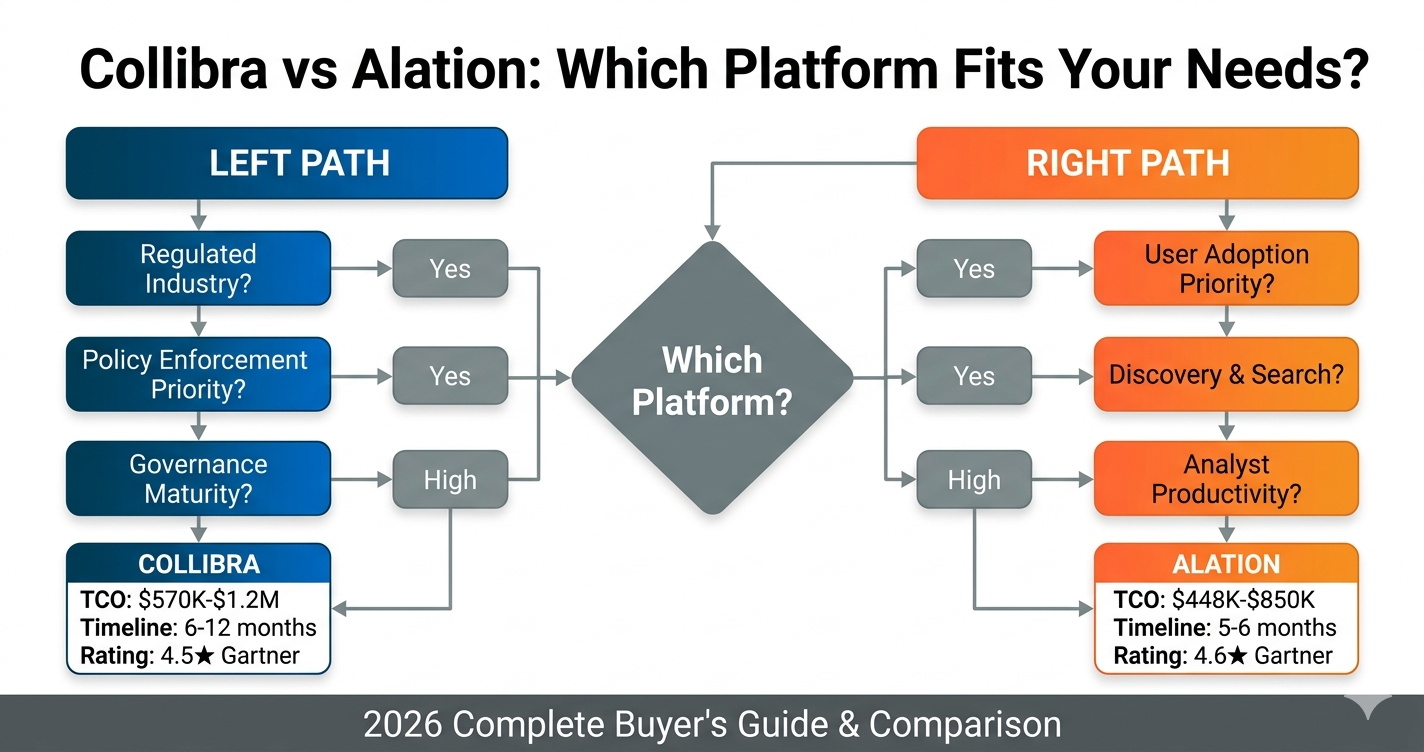
Collibra: Enterprise-grade governance platform covering data catalog, business glossary, data lineage, policy management, and workflow automation. Strong in regulated industries. Implementation complexity is high — you need dedicated configuration resources. I’ve used it in financial services and government contexts where audit trail and workflow formality are non-negotiable.
Microsoft Purview: Strong choice for Azure-heavy organizations. Native integration with Azure Data Factory, Synapse, SQL, and Fabric makes automated scanning and lineage capture straightforward. Sensitivity label integration with Microsoft 365 is a differentiator for organizations managing both structured data and unstructured documents. Less mature than Collibra for complex business glossary and stewardship workflows.
Informatica IDMC / Axon: Comprehensive platform covering MDM, data quality, catalog, and governance. Strongest data quality execution engine in the market. Better fit for organizations where data quality remediation is the primary driver.
Alation: Strong in self-service analytics environments. Known for behavioral intelligence — surfacing frequently used datasets and trusted query patterns. Good fit for data literacy and data discovery use cases.
Profisee: MDM-focused platform with strong Azure integration. More accessible price point than Informatica. Well-suited for mid-market and organizations standardizing on Azure cloud.
For evaluation, I use a structured scorecard covering: alignment to use case priority, native integration with existing data stack, stewardship and workflow UX (business users have to actually use this), lineage coverage depth, metadata model extensibility, vendor roadmap for AI governance, and total cost of ownership including implementation services.
How do you implement data lineage, and why is it a governance priority?
Why they ask it: Lineage is foundational for impact analysis, regulatory compliance, and trust in data products. It’s also one of the hardest things to get right at enterprise scale.
Strong answer framework: Data lineage documents the movement and transformation of data from source systems through pipelines to consuming applications. It answers: where did this data come from, what happened to it, and who is consuming it?
Lineage is a governance priority because it enables: impact analysis before changes to source systems or pipelines, compliance demonstration for data flow regulations (GDPR cross-border transfers, BCBS 239 data traceability), root cause analysis when quality issues surface in reports, and trust in AI/ML model outputs by documenting training data provenance.
Implementation approach depends on scale. At the tool level, most modern catalogs (Purview, Collibra, Alation) support automated lineage capture through scanner connectors for major platforms (Databricks, Snowflake, dbt, ADF). The challenge is coverage gaps — custom pipelines, legacy ETL, and APIs often require manual lineage documentation or custom connector development. A hybrid approach — automated capture where supported, templated manual documentation for gaps — is the practical enterprise approach.
One important point: lineage is only valuable if it’s maintained. A snapshot of lineage taken at point-in-time becomes stale quickly. Embed lineage refresh triggers in your CI/CD pipeline so that deployments automatically update lineage metadata.
What is Master Data Management, and how does it relate to data governance?
Why they ask it: MDM is frequently part of governance programs, and conflating them or separating them completely are both errors.
Strong answer framework: Master Data Management is the technology-enabled process for creating and maintaining a single, authoritative, trusted version of core business entities — customers, products, suppliers, employees, locations. MDM solves the problem of fragmented, inconsistent entity records across multiple systems of record.
Governance and MDM are complementary but distinct. MDM is a technical implementation — a hub architecture, matching rules, survivorship logic, data stewardship workflows. Governance provides the policy and accountability context that makes MDM work: who owns the Customer domain, what is the authoritative definition of “active customer,” who has the authority to merge records, what is the SLA for steward resolution of match exceptions?
Without governance, MDM implementations drift — no one owns the matching rules after the initial implementation, data quality thresholds aren’t enforced, and the “golden record” degrades. Without MDM, governance has no technical mechanism for entity resolution at scale. They belong together.
Metrics and Program Measurement Interview Questions
How do you measure the success of a data governance program?
Why they ask it: Governance programs fail when they can’t demonstrate value. They want to see if you can connect governance activities to business outcomes.
Strong answer framework: Governance metrics should operate at three levels:
Activity metrics (program is operating): Number of data assets cataloged, business glossary terms defined and approved, active stewards in the network, policy coverage by domain, issues logged and resolved. These prove the program is running — they don’t prove it’s valuable.
Quality outcome metrics (governance is working): Data quality scores by domain and dimension, trend in data quality issues over time (are defect rates falling?), time-to-resolution for data incidents, source system completeness rates. These demonstrate that governance activity is improving the data.
Business impact metrics (governance is delivering value): Reduction in time-to-close regulatory audits, reduction in data rework cost, improvement in analytics accuracy (tied to validated business decisions), compliance posture improvement measured by audit finding trends, MDM match rate improvement tied to CAC or NPS accuracy.
The mistake most governance programs make is reporting only activity metrics to leadership. Executives don’t care how many glossary terms are defined — they care whether the data powering their P&L report is accurate, whether the last regulatory exam went well, and whether the AI initiative can actually launch. Connect your metrics to those outcomes.
What is a data governance maturity model, and how have you used one?
Why they ask it: Maturity models are a governance planning and communication tool. They want to see if you can assess where an organization is and roadmap where it needs to go.
Strong answer framework: A data governance maturity model is a structured framework for assessing the current state of a governance program across key capability dimensions — typically ranging from Level 1 (ad hoc, reactive, no formal governance) to Level 5 (optimized, enterprise-wide, quantitatively managed).
Common maturity models include: Stanford Data Governance Maturity Model, CMMI Data Management Maturity Model (DMM), Gartner’s Data Management Maturity framework, and vendor-specific models from Collibra and IBM.
In practice, I use maturity assessments at two points: at program inception (to establish a baseline and build the business case for investment) and annually (to demonstrate progress and recalibrate priorities). The assessment itself should involve interviews with data owners, stewards, IT stakeholders, and compliance — not just self-scoring by the governance team, which tends to be optimistic.
The output should be a capability heatmap and a prioritized roadmap. Not every organization needs to reach Level 5 in every capability — the target maturity level should be calibrated to the organization’s strategic priorities and regulatory obligations.
AI Governance Interview Questions (2026-Specific)
AI governance is now a standalone interview category in most senior data governance roles. If you’re interviewing for a CDO, Data Governance Lead, or Director-level position, expect two to four questions specifically on AI.
What is AI governance, and how does it differ from traditional data governance?
Why they ask it: AI governance is emerging as a distinct discipline, but it’s deeply connected to data governance. They want to see if you can articulate the relationship and the differences.
Strong answer framework: Traditional data governance focuses on data assets — their quality, lineage, classification, access controls, and policy compliance. AI governance extends that accountability to the models and automated systems that consume data to make or support decisions.
The distinctions that matter:
- Explainability requirements: A data governance program ensures the Customer database is accurate. An AI governance program must ensure that a credit model using that database can be explained to a regulator or to the consumer being denied credit — and that the explanation is meaningful.
- Bias and fairness: Data governance enforces data quality standards. AI governance must additionally test for discriminatory patterns in model outputs that may not be visible in the training data itself.
- Model lifecycle governance: AI governance requires version control, audit trails, approval workflows, and monitoring for model drift — capabilities that traditional catalog tools are only beginning to support.
- Human oversight: Particularly under the EU AI Act, high-risk AI systems must have documented human oversight mechanisms — not just accurate data feeding them.
In 2026, the leading governance platforms (Collibra, Informatica, Purview) are all building AI governance modules. Most organizations are running governance for AI assets on top of their existing catalog infrastructure, with extensions for model metadata, bias testing results, and deployment approvals.
How would you build a governance framework for an organization’s AI model inventory?
Why they ask it: This is a builder question — they want to see if you can design a program, not just describe one.
Strong answer framework: Start with inventory. You can’t govern what you don’t know exists. Build a model registry in your catalog that captures: model name and version, business use case and owner, risk classification (following the EU AI Act tiering — unacceptable, high, limited, minimal), training dataset references (with links to catalog records for those datasets), performance metrics, bias testing results, deployment approval status, and monitoring schedule.
Layer governance workflows on top: a model intake process (new models require review before production deployment), a risk assessment process (high-risk models require additional documentation and potentially third-party review), and a monitoring protocol (automated drift detection alerts routed to model owners and stewards).
Establish roles: an AI Governance Council (cross-functional, including Legal, Compliance, Data Science leadership, and the CDO), AI Model Owners (typically the business unit sponsoring the model), and AI Data Stewards (accountable for the quality of training and inference datasets).
Tie the framework to your existing governance infrastructure — the same catalog, the same policy hierarchy, the same escalation paths — rather than building a parallel governance silo for AI. Parallel programs always fragment.
What is model drift, and why is it a governance issue?
Why they ask it: This is a technical-governance bridge question. It tests whether you can speak both languages.
Strong answer framework: Model drift occurs when the statistical properties of the input data or target variable change over time, causing a model’s predictions to become less accurate or less appropriate. There are two types: data drift (the distribution of input features changes) and concept drift (the relationship between inputs and the target variable changes).
Drift is a governance issue — not just a data science issue — because it means that a model approved and deployed at one point in time may be making materially different decisions months later, without anyone in the organization knowing. From a regulatory standpoint (particularly under the EU AI Act and SR 11-7 model risk guidance for financial services), organizations are required to monitor model performance post-deployment and have processes for revalidation and redeployment approval when drift is detected.
Governance’s role is to ensure that monitoring requirements are documented in model metadata, that drift alerts are routed to model owners with SLAs for response, and that revalidation workflows mirror the original approval process — not a shortcut that bypasses risk review.
Behavioral and Situational Interview Questions
These are frequently the questions that determine the outcome of mid-to-senior level governance interviews. Technical competence is table stakes; behavioral evidence of leadership, conflict management, and program execution is what gets you the offer.
Tell me about a time you had to drive data governance adoption across a business unit that was resistant.
Why they ask it: Governance requires influence without authority. This question is a direct test of your change management and stakeholder management skills.
Strong answer framework (STAR):
The most effective change management approach I’ve seen in governance is to make resistance visible in business terms — not governance terms. When a business unit says “governance slows us down,” the conversation needs to shift to: “Last quarter, this team spent 340 analyst hours reconciling conflicting definitions between the sales and finance data. That’s the cost of no governance. Here’s what the first 90 days of a stewardship program looks like, and here’s the time it saves.”
Find a quick win in the resistant unit. Don’t start with the most complex governance capability — start with the data quality issue that’s causing them the most pain. Solve it visibly and attribute the win to governance. Champions are made through demonstrated value, not policy mandates.
Executive sponsorship is your lever when business units won’t engage. If the CDO or CIDO has signed off on the governance mandate and it’s reflected in the resistant unit’s leadership objectives, the conversation changes quickly.
Describe a situation where you identified a significant data risk and had to escalate it to leadership.
Why they ask it: Governance practitioners need to be effective risk communicators, not just risk identifiers. They want to see your judgment about what constitutes a material risk and your ability to communicate it clearly to non-technical executives.
Strong answer framework: Structure the escalation around business impact, not technical details. Leadership doesn’t need to understand the technical root cause of a data risk — they need to understand what could go wrong, for whom, by when, and what the remediation options are with their associated costs.
A strong escalation narrative sounds like: “We have identified that our customer consent records have an integrity gap affecting approximately 180,000 records. Under CCPA, unverifiable consent exposes us to per-record penalties and a potential enforcement action if a consumer complaint triggers an audit. The remediation options are: re-consent campaign at X cost and 90-day timeline, or data quarantine pending re-consent at the cost of marketing access to those records. We recommend the re-consent approach. Here’s what we need from you to proceed.”
The key is options and a recommendation. Escalating a risk with no path forward is not effective governance — it creates anxiety without resolution.
How do you build the business case for a data governance investment?
Why they ask it: This is a leadership and business acumen question, increasingly important as governance programs compete for budget with higher-profile digital transformation initiatives.
Strong answer framework: A governance business case needs to speak three languages simultaneously: risk reduction, cost avoidance, and value creation.
Risk reduction: What regulatory fines, audit findings, or operational failures does poor governance create? Quantify the exposure. A GDPR fine at 4% of global annual turnover is a number you can put in a slide.
Cost avoidance: What is the current cost of bad data? Analyst rework hours, reconciliation time, failed analytics projects, duplicate vendor records inflating procurement costs? Gartner’s oft-cited figure of $12.9M average annual cost of poor data quality gives you an industry anchor; ideally you conduct an internal assessment specific to the organization.
Value creation: What becomes possible with governed data that isn’t possible now? Analytics initiatives that can be trusted, AI systems that can be approved and deployed, faster regulatory reporting, more accurate customer insights. Connect governance investment to strategic initiatives already on the executive agenda.
The format that works: a one-page executive summary with risk/cost/value tied to the current fiscal year, a 12-month roadmap with milestone gates, and a requested investment with ROI projection. Keep the detail in an appendix.
Role-Specific Questions: What to Expect at Each Level
Entry-Level and Data Steward Roles
At the entry level, expect questions focused on conceptual understanding, tool familiarity, and evidence of attention to detail. Typical questions:
- “What does a data steward do on a day-to-day basis?”
- “How would you document a business glossary term?”
- “What tools have you worked with for data cataloging or data quality?”
- “Walk me through how you would handle a data quality issue reported by a business user.”
The differentiator at this level: candidates who have done anything hands-on with data catalog tools (even personal projects or certifications), who can demonstrate curiosity about business context, and who understand that stewardship is a business accountability — not an IT task.
Mid-Level: Data Governance Analyst and Governance Lead
At this level, expect scenario-based questions alongside behavioral assessments. Typical questions:
- “How do you prioritize which data assets to catalog first when resources are constrained?”
- “Describe your approach to building a business glossary from scratch.”
- “How do you handle conflicts between two data owners who disagree on a data definition?”
- “Walk me through a governance metrics dashboard you’ve built or contributed to.”
The differentiator at this level: evidence of program management capability, ability to facilitate cross-functional working groups, and a track record of measurable quality improvement.
Senior and Principal: Data Governance Engineer and Program Manager
At this level, expect deep technical questions alongside governance strategy. Typical questions:
- “How would you design a metadata management architecture for a hybrid cloud environment?”
- “Describe your experience with automated data quality monitoring and observability.”
- “How have you integrated governance tooling with CI/CD pipelines?”
- “How do you approach data governance for a data mesh architecture?”
The differentiator at this level: architectural judgment, tool implementation depth, and the ability to connect technical design decisions to governance outcomes.
Director and CDO Level
At the executive level, strategy, organizational design, and regulatory posture are primary. Typical questions:
- “How would you structure a data governance operating model for a 50,000-person enterprise?”
- “What is your approach to building a data governance budget and defending it to the CFO?”
- “How do you measure and communicate the ROI of a governance program to the board?”
- “How are you thinking about AI governance as a CDO responsibility in 2026?”
The differentiator at this level: demonstrated ability to build and scale programs, executive communication, and a point of view on the future of the discipline.
Questions You Should Ask the Interviewer
The questions you ask signal your priorities, your experience level, and your genuine interest in the role. These are strong questions to have ready:
On program maturity: “Where would you place the current governance program on a maturity scale? What are the two or three capability gaps you’re most focused on closing this year?”
On executive support: “How visible is the governance program to the C-suite? Does the CDO or CIDO have a seat at the table, and is governance included in business unit leadership objectives?”
On tooling: “What does your current governance tooling stack look like? Are there active initiatives to expand catalog coverage or improve lineage automation?”
On the team: “How is the governance team structured — is it centralized, federated, or a hybrid model? How large is the steward network, and how actively engaged are business stewards?”
On AI governance: “Has the organization started addressing EU AI Act compliance requirements? Is AI governance being treated as a governance office responsibility or a separate initiative?”
On success: “What does success look like for this role in the first 90 days? What are the two or three most important things you’d want someone coming into this role to accomplish in year one?”
Final Preparation Checklist
Before your interview, confirm you can speak to each of these with a real example:
- Your definition of data governance and the business case for it ✓
- The governance framework components you’ve worked with ✓
- A specific data quality initiative with quantified outcomes ✓
- Your experience with at least two governance or catalog tools ✓
- A compliance or regulatory implementation you contributed to ✓
- How you’ve navigated stakeholder resistance or cross-functional conflict ✓
- How you measure governance program success ✓
- Your point of view on AI governance and the EU AI Act ✓
- Questions that demonstrate strategic interest in the role ✓
The candidates who succeed in data governance interviews in 2026 are the ones who can bridge practitioner depth with strategic thinking — who speak in business outcomes, not just technical frameworks, and who have real stories to back up every claim they make.
That’s the standard. Now go crush it.