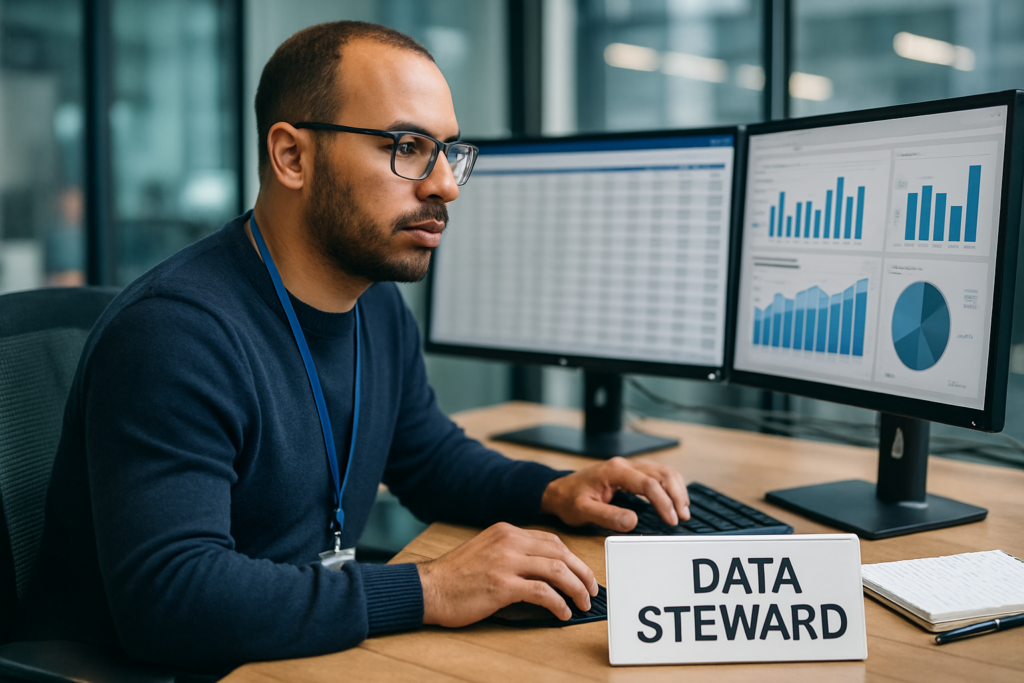
A data steward is a subject matter expert designated to oversee the quality, usability, and governance of specific data domains within an organization. Data stewards serve as the operational link between data governance policy and daily data management practice — ensuring that data meets quality standards, access controls are properly enforced, business metadata is documented, and data is used appropriately within their assigned domain.
In 2026, the data steward role has evolved from a primarily technical function to a strategic business position. Organizations recognize that effective data governance cannot be centralized in a single team — it requires distributed stewardship with business-side experts who understand both the data and the business context in which it’s used. Data stewards translate governance policies into operational reality, making the abstract concept of “data as an asset” tangible through day-to-day data management.
This comprehensive guide is written for data governance professionals, aspiring data stewards, CDOs building stewardship programs, and business leaders evaluating whether their organization needs dedicated data stewards. You’ll learn what data stewards actually do in practice, how data stewardship differs from related roles like data owners and data custodians, what organizational models work for different contexts, how to build a successful stewardship program, what skills make effective data stewards, and how the role is evolving with AI and automation.
This isn’t theoretical HR job description content from consultants. It’s practical wisdom from organizations that have built successful stewardship programs through trial, error, and continuous improvement.
- The Data Steward Role Explained
- Why Organizations Need Data Stewards
- Data Steward vs. Data Owner vs. Data Custodian
- What Data Stewards Actually Do Daily
- Types of Data Stewards
- Building a Data Stewardship Program
- Skills and Qualifications for Data Stewards
- Data Stewardship Organizational Models
- Common Data Steward Challenges
- Measuring Data Steward Effectiveness
- Tools Data Stewards Use
- The Future of Data Stewardship
- Becoming a Data Steward: Career Path
- Frequently Asked Questions
- Summary
The Data Steward Role Explained
The data steward is the practitioner who makes data governance operational. While data governance councils set policies and chief data officers establish frameworks, data stewards execute governance in daily workflows.
The Core Mandate
Data stewards are accountable to data owners for ensuring that data within their assigned domain meets quality standards, is properly documented, and is governed according to organizational policies. The steward doesn’t necessarily create the data or own the systems where it resides, but they ensure that data remains trustworthy and usable.
The steward operates at the intersection of business and technology. They understand business processes well enough to define what “quality” means for their data domain, and they understand technology sufficiently to work with data engineers and architects on quality improvement.
Strategic vs. Operational Stewardship
Some organizations distinguish between strategic and operational stewardship. Strategic stewards (often called “enterprise data stewards” or “domain data stewards”) have broad accountability for major data domains like customer data, product data, or financial data across the entire organization. Operational stewards (sometimes called “data quality analysts” or “dataset stewards”) focus on specific systems, applications, or datasets.
Both are essential. Strategic stewards define domain-wide standards and resolve cross-system issues. Operational stewards ensure day-to-day data quality in specific applications.
Part-Time vs. Full-Time Stewardship
In smaller organizations or for mature, well-governed data domains, stewardship may be a part-time responsibility added to someone’s existing role — a finance manager who spends 20% of their time as financial data steward, or a senior customer service representative who dedicates one day per week to customer data stewardship.
In large organizations or for critical, complex data domains, stewardship becomes a full-time dedicated role. A large healthcare system might employ full-time clinical data stewards. A major bank might have dedicated customer data stewards across multiple business units.
The determination depends on data volume, complexity, criticality, and regulatory requirements.
Why Organizations Need Data Stewards
Not every organization needs formal data stewards. Small companies with simple data environments and low regulatory pressure can often manage data quality through informal practices. But specific organizational contexts create clear stewardship need.
Data Quality Problems at Scale
When organizations reach a size and complexity threshold, data quality issues multiply beyond what can be managed informally. Different departments define “customer” differently. Product codes proliferate without standardization. Data entry errors accumulate. Master data becomes fragmented across dozens of systems.
These quality problems cost real money — billing delays, duplicate marketing spend, inventory inaccuracies, and poor analytics based on bad data. Organizations experiencing systematic data quality problems need dedicated stewardship to systematically improve quality.
Regulatory Compliance Requirements
Regulated industries — financial services, healthcare, telecommunications, pharmaceuticals — face explicit requirements for data quality and lineage documentation. Regulators increasingly ask: “Who is accountable for this data? How do you ensure it’s accurate? Can you demonstrate data lineage?”
These questions cannot be answered without stewardship. Stewards provide the named accountability regulators expect. They maintain the metadata and lineage documentation compliance requires. They execute the data quality controls that satisfy regulatory audits.
Master Data Management Initiatives
Organizations implementing master data management (MDM) to create “golden records” of customers, products, or other critical entities absolutely require stewardship. MDM systems don’t magically produce quality master data — stewards must define matching rules, resolve duplicates, establish survivorship rules, and continuously monitor master data quality.
Without dedicated stewards, MDM implementations fail. The technology works but nobody governs what goes into it, and master data quality degrades until the MDM system is abandoned.
Data-Driven Digital Transformation
Organizations undergoing digital transformation — implementing AI and machine learning, building data products, enabling self-service analytics — need stewardship to ensure transformation rests on quality data foundations.
AI models trained on poor data produce poor results. Analytics democratization without stewardship leads to inconsistent metrics and contradictory insights. Stewards ensure that digital transformation delivers business value rather than just deploying modern technology on broken data.
Organizational Symptoms Indicating Stewardship Need
Specific symptoms signal stewardship need:
Business decisions are delayed because nobody can authoritatively answer “what does this data actually mean?” Different departments report conflicting metrics for the same business concept. Data access requests languish because nobody knows who should approve access. Data quality issues are identified but nobody is responsible for fixing them. Multiple teams independently define business terms without coordination. New systems are deployed without consideration for data standards. Analysts spend more time questioning data than analyzing it.
These symptoms all point to lack of operational data accountability — the gap data stewards fill.
Data Steward vs. Data Owner vs. Data Custodian
The data steward role is often confused with related roles. Understanding the distinctions is essential for effective governance.
Data Owner
The data owner is a senior business leader accountable for data quality and appropriate use within their domain. Typically a vice president, director, or department head, the data owner makes strategic decisions about data: Who should have access? What quality standards apply? How should data be defined? What business rules govern data use?
The data owner has ultimate accountability but typically lacks time for day-to-day data management. This is where data stewards come in.
Example: The VP of Sales is the data owner for customer data. She is accountable for customer data quality and appropriate use, but she doesn’t personally cleanse customer records or document customer data definitions. She delegates operational stewardship to a customer data steward who reports to her.
The relationship: Data stewards are designated by data owners to operationally execute the owner’s accountability.
Data Custodian
The data custodian is an IT professional responsible for the technical infrastructure where data is stored — database administrators, system administrators, cloud platform engineers. Custodians ensure databases run reliably, backups execute properly, storage capacity is adequate, and systems are secure.
The custodian manages the technology. The steward manages the data quality and usability within that technology.
Example: A database administrator (custodian) ensures the customer database runs 24/7 with proper backups and security. The customer data steward ensures customer records in that database are accurate, complete, and properly documented.
The relationship: Stewards and custodians collaborate closely. Stewards identify data quality issues; custodians may implement technical solutions. Custodians provide technical capabilities; stewards define how those capabilities should be used for data quality.
Data Analyst
The data analyst uses data to generate insights and inform business decisions. Analysts query data, build reports, create dashboards, and develop analytical models.
The analyst is a consumer of data. The steward is responsible for ensuring the data consumed is trustworthy.
Example: A business analyst builds sales performance dashboards. The sales data steward ensures the sales data feeding those dashboards is accurate, properly categorized, and well-documented so the analyst understands what they’re analyzing.
The relationship: Effective stewardship makes analysts more productive. When stewards maintain data quality and metadata, analysts spend less time questioning data and more time generating insights.
Data Governance Analyst
The data governance analyst (or data governance coordinator) works on the enterprise governance program — documenting policies, coordinating governance councils, managing governance projects, and supporting governance tools.
This role focuses on governance as a program. The data steward focuses on governing specific data domains.
Example: A data governance analyst documents the organization’s data classification policy and trains employees on classification. A data steward applies that policy by actually classifying data in their domain.
The relationship: Governance analysts provide the framework and support. Stewards execute governance in practice.
What Data Stewards Actually Do Daily
The data steward role is practical and operational. Here’s what stewards actually spend time doing.
Data Quality Monitoring and Remediation
Stewards continuously monitor data quality in their domain. This includes running data quality reports identifying issues, investigating root causes of data errors, coordinating remediation with system owners and business users, and tracking quality metrics over time.
When a quality issue surfaces — duplicate customer records, incorrect product classifications, missing required fields — the steward investigates why it occurred and drives correction. This may involve working with data entry staff to improve processes, coordinating with IT to implement validation rules, or updating training materials.
Business Metadata Management
Stewards document what data means in business terms. They define business glossary terms, maintain data dictionaries documenting each data element’s meaning and valid values, enrich data catalog entries with business context, and map technical data to business concepts.
When a new analyst joins and asks “what does ‘customer lifetime value’ mean in our systems?”, the steward provides the authoritative answer — and ensures that definition is documented so future analysts don’t need to ask.
Data Access Governance
Stewards often serve as the approval authority for data access requests within their domain. They review requests, assess whether access is appropriate based on business need, approve or deny requests, and maintain documentation of who has access and why.
This operational role ensures access governance isn’t theoretical. Someone with business context is actually evaluating whether data access makes sense.
Data Lineage Documentation
Stewards maintain understanding of where data originates, how it transforms through systems, and where it’s ultimately used. They document data lineage, track data flows across systems, and explain to stakeholders how data moves through the organization.
When a C-level executive asks “where does this number come from?”, the steward can trace the lineage from source systems through transformations to final reports.
Cross-Functional Collaboration
Stewards serve as the liaison between business units, IT, analytics teams, and compliance. They translate business requirements into technical specifications, explain technical constraints to business stakeholders, coordinate data projects across organizational boundaries, and ensure data initiatives align with business needs.
Issue Escalation and Resolution
When data issues exceed the steward’s authority to resolve — conflicts between departments over data definitions, system changes impacting data quality, resource needs for data improvement projects — stewards escalate to data owners or governance councils.
Effective stewards know when to resolve issues independently and when escalation is needed.
Types of Data Stewards
Data stewardship isn’t one-size-fits-all. Organizations implement different steward types based on their needs.
Business Data Steward
Business data stewards are subject matter experts from business units with deep domain knowledge. They understand business processes, know how data is created and used, and can authoritatively define what data should look like.
Example: A senior procurement specialist serving as supplier data steward understands vendor management processes intimately and can define quality standards for vendor records based on how procurement actually works.
When used: When data governance requires business context and domain expertise that IT doesn’t possess. Most effective for customer data, product data, supplier data, and other business-critical domains.
Technical Data Steward
Technical data stewards have IT backgrounds — often data engineers, database administrators, or business intelligence developers. They understand system architectures, data models, and technical constraints.
Example: A data engineer serving as data warehouse steward understands the warehouse’s technical architecture and can define standards for how source systems should load data into the warehouse.
When used: For technical data domains like metadata, reference data, system configuration data, and technical master data where IT expertise is primary.
Executive Data Steward
Executive data stewards are senior leaders providing strategic direction and authority for major data domains. Often called “domain data stewards” or “enterprise data stewards,” they don’t handle day-to-day stewardship but set strategic direction.
Example: The Chief Marketing Officer serving as executive steward for all marketing data, providing strategic direction while operational stewards handle daily management.
When used: In large organizations with complex data domains requiring executive-level strategic direction and cross-functional authority.
Data Quality Steward
Data quality stewards specialize in data quality management. They operate data quality tools, investigate quality issues, define quality rules and metrics, and drive quality improvement initiatives.
Example: A data quality analyst who runs daily quality reports, triages quality issues, and works with business users to remediate bad data.
When used: In organizations with dedicated data quality initiatives or complex quality challenges requiring specialized focus.
Data Privacy and Security Steward
Privacy and security stewards focus on data protection, privacy compliance, and security governance. They classify data by sensitivity, monitor for privacy violations, manage consent and preferences, and ensure security controls are properly configured.
Example: A privacy specialist who classifies customer data, ensures PII is properly protected, and manages customer consent preferences.
When used: In regulated industries or organizations handling sensitive data requiring specialized privacy and security expertise.
Building a Data Stewardship Program
Creating an effective stewardship program requires more than appointing stewards and hoping for the best.
Defining Stewardship Scope and Domains
The first decision is what data will be stewarded. Organizations typically prioritize high-value, high-risk, or high-use data domains rather than attempting to steward all data immediately.
Prioritization criteria:
Business criticality: Data essential to core business processes gets priority. Regulatory risk: Data subject to compliance requirements needs immediate stewardship. Quality problems: Domains with known quality issues justify stewardship investment. Transformation enablement: Data needed for strategic initiatives gets prioritized.
Common initial domains: customer/client data, product data, financial data, employee data, and supplier/vendor data.
Establishing Stewardship Authority
Stewards need real authority or they become ineffective. The governance framework must explicitly grant stewards authority to:
Approve or deny data access requests within defined parameters. Require remediation of data quality issues. Set standards for data entry and maintenance. Review and approve system changes impacting their data domain. Represent business interests in data architecture decisions.
Without authority, stewards become advisors who document problems without ability to fix them.
Securing Steward Time Allocation
The most common stewardship program failure is appointing stewards who have no allocated time for stewardship. A finance manager “appointed” as financial data steward but still expected to fulfill 100% of their management role has zero capacity for stewardship.
Effective programs explicitly allocate time: “Sarah will dedicate 20% time (one day per week) to customer data stewardship, and her performance goals will reflect both customer service management and stewardship responsibilities.”
For full-time stewards, the role must be formally created with job description, hiring process, and clear reporting structure.
Providing Steward Training and Support
Most people appointed as stewards have never been stewards before. They need training on:
Data governance principles and the organization’s governance framework. Their specific stewardship responsibilities and authority. Tools they’ll use (data catalog, data quality platforms, data modeling tools). Processes for escalation and issue resolution. How to collaborate with IT, business, and governance teams.
Ongoing support through a stewardship community, regular steward meetings, and access to governance staff is essential.
Creating Stewardship Workflows
Stewards need defined workflows for recurring activities:
Data quality triage workflow: How quality issues are identified, assigned, investigated, remediated, and tracked to closure.
Access request workflow: How requests are submitted, reviewed, approved/denied, and fulfilled.
Metadata enrichment workflow: How business terms are defined, reviewed, approved, and published.
Change impact workflow: How system changes impacting data are reviewed and approved by stewards.
Without defined workflows, stewardship becomes ad hoc and inconsistent.
Skills and Qualifications for Data Stewards
Effective data stewards blend business acumen, technical competence, and interpersonal skills in ways that are rare.
Business Domain Expertise
The most critical steward qualification is deep knowledge of the business domain. A customer data steward must understand customer lifecycle, segmentation, and relationship management. A product data steward must understand product development, categorization, and lifecycle.
This domain expertise cannot be taught quickly. Organizations typically select stewards from experienced business professionals rather than hiring external candidates without domain knowledge.
Data Literacy
Stewards need solid data literacy — understanding of data concepts, basic SQL ability to query data, comfort with spreadsheets and data tools, and comprehension of data modeling concepts.
They don’t need to be data engineers, but they must be comfortable working with data rather than intimidated by it.
Analytical and Problem-Solving Skills
Data stewardship requires investigation and root cause analysis. When data quality issues arise, stewards must diagnose why they occurred — was it process failure, system configuration, user error, or integration issues?
Strong analytical skills and methodical problem-solving approaches are essential.
Communication and Collaboration
Stewards constantly bridge between technical and business stakeholders. They must explain technical concepts to business users, translate business requirements for IT, negotiate solutions across organizational boundaries, and influence without direct authority.
Excellent communication skills and collaborative approach are non-negotiable.
Attention to Detail
Data stewardship involves meticulous work — documenting metadata, reviewing data definitions, checking quality metrics, and maintaining lineage documentation. Missing details leads to stewardship failures.
Successful stewards are naturally detail-oriented without losing sight of strategic objectives.
Political and Organizational Savvy
Stewards often navigate organizational politics — resolving conflicts between departments over data definitions, securing resources for data quality projects, and influencing senior leaders to prioritize data issues.
Political skill and organizational understanding help stewards be effective.
Data Stewardship Organizational Models
Organizations structure stewardship differently based on their context.
Centralized Stewardship Model
In centralized stewardship, all stewards report to a central data governance office or CDO organization. Stewards are full-time dedicated roles within the governance team.
Advantages: Stewards develop deep governance expertise, consistency across domains is easier to maintain, stewards can be reallocated based on priorities, and clear career path for stewardship professionals.
Disadvantages: Stewards may become disconnected from business operations, business units may resist “outsiders” governing their data, and cost of full-time dedicated stewardship team is significant.
When it works: Large organizations with complex governance needs, mature governance programs, and commitment to governance as a core organizational function.
Federated Stewardship Model
In federated stewardship, stewards remain in business units but are designated for stewardship roles. A finance department employee continues reporting to the CFO while serving as financial data steward. Stewardship is 10-30% of their role.
Advantages: Stewards maintain strong business connections and context, business units retain ownership of their data stewardship, and cost is distributed across organization rather than centralized.
Disadvantages: Stewardship competes with “day job” responsibilities, inconsistency across domains is more likely, and steward capability varies based on who business units designate.
When it works: Mid-size organizations, distributed organizations with strong business unit autonomy, and early-stage governance programs building credibility.
Hybrid Stewardship Model
Hybrid approaches combine centralized and federated elements. Core enterprise stewards are centralized (customer data steward, product data steward), while business unit stewards are federated (individual business units have their own operational stewards for local data).
Advantages: Balances consistency with local autonomy, provides professional stewardship for critical domains while engaging business units, and allows appropriate model for each domain.
Disadvantages: More complex to coordinate, potential for confusion about roles and authority, and requires more sophisticated governance maturity to execute.
When it works: Large complex organizations, multi-business unit enterprises, and mature governance programs with resources for sophisticated models.
Common Data Steward Challenges
Understanding typical steward challenges helps organizations provide appropriate support.
Lack of Time and Competing Priorities
The most common challenge: stewards appointed without time allocation. When stewardship is added to an already full-time role without removing anything else, stewardship gets deprioritized.
The solution: Explicit time allocation (20% time = one day per week), stewardship reflected in performance goals, and management support for stewardship taking precedence over some routine responsibilities.
Unclear Authority and Accountability
Stewards appointed without real authority become frustrated. They identify problems but cannot require action. They recommend improvements but cannot allocate resources.
The solution: Governance charter explicitly defining steward authority, executive support for steward decisions, and escalation paths when authority is challenged.
Business Resistance to Governance
Business users sometimes view stewardship as bureaucratic interference. “Why do I need a steward’s approval to access data? I’ve always had access.”
The solution: Stewards demonstrating value rather than just imposing restrictions, business-friendly processes minimizing friction, and success stories showing how stewardship enabled better outcomes.
Inadequate Tools and Technology
Stewards expected to manage metadata in spreadsheets, track quality issues in email, and document lineage in PowerPoint become overwhelmed.
The solution: Investment in data governance platforms (Collibra, Alation, Informatica), data quality tools, and data catalogs that make stewardship operationally sustainable.
Isolation and Lack of Community
Stewards often feel isolated — the only person in their business unit focused on data governance, without peers to consult or learn from.
The solution: Regular steward community meetings, steward collaboration channels (Slack, Teams), and steward training and development programs.
Measuring Data Steward Effectiveness
Organizations must measure stewardship value to justify continued investment.
Data Quality Metrics
Data quality improvement in stewarded domains vs. non-stewarded domains. Track completeness (percentage of required fields populated), accuracy (error rates), consistency (duplicate rates), and timeliness (data freshness).
Stewardship should demonstrate measurable quality improvement over time.
Metadata Completeness
Metadata coverage as percentage of data assets with business definitions, data owner documentation, data classification tags, and quality metrics.
Stewardship should steadily increase metadata completeness.
Access Request Cycle Time
Time from access request to fulfillment in stewarded domains. Effective stewardship streamlines access rather than creating bottlenecks.
Target: access decisions within 1-2 business days for routine requests.
Data Issue Resolution Time
Time from quality issue identification to remediation tracked by severity. Critical issues should be resolved in days, moderate issues in weeks.
Stewardship should accelerate issue resolution through clear ownership.
Business User Satisfaction
Steward responsiveness and helpfulness as rated by business users, IT partners, and data consumers.
Stewards should be viewed as enablers rather than blockers.
Steward Activity Metrics
Steward productivity measured by metadata entries created/updated, quality issues triaged, access requests processed, and lineage documentation maintained.
These activity metrics validate that stewards are actively stewarding rather than stewardship being nominal.
Tools Data Stewards Use
Effective stewardship requires appropriate technology support.
Data Catalog Platforms
Data catalogs (Collibra, Alation, Microsoft Purview, Informatica EDC) serve as the operational hub for stewards. Stewards use catalogs to document business metadata, enrich data asset descriptions, manage data ownership, classify data, and maintain data lineage.
Modern catalogs with workflow capabilities allow stewards to collaborate on metadata enrichment, route definitions for approval, and track stewardship activity.
Data Quality Tools
Data quality platforms (Informatica Data Quality, Talend, IBM InfoSphere) allow stewards to profile data to identify quality issues, define quality rules, monitor quality metrics, and track remediation.
Some stewards may not directly operate quality tools (data engineers might handle technical operation), but stewards define business quality rules and interpret quality reports.
Master Data Management Systems
MDM platforms (Informatica MDM, Profisee, SAP MDM) are heavily dependent on stewardship. Stewards define matching rules, resolve duplicate records, establish survivorship rules, and monitor master data quality.
MDM without stewardship is technology without governance.
Business Intelligence and Analytics Platforms
Stewards use BI tools (Tableau, Power BI, Qlik) not primarily for analysis but to:
Review data quality dashboards monitoring stewardship domains. Identify anomalies and quality issues through visualization. Validate that governed data is being used in analytics.
Collaboration Platforms
Slack, Microsoft Teams, SharePoint facilitate steward collaboration. Stewards use these for questions to subject matter experts, collaboration on metadata definitions, escalation of issues, and steward community building.
Data Modeling Tools
Technical stewards may use data modeling tools (ERwin, PowerDesigner) to understand logical and physical data models, ensure stewardship aligns with data architecture, and document technical metadata.
The Future of Data Stewardship
Data stewardship is evolving as technology and organizational contexts change.
AI-Assisted Stewardship
AI is augmenting steward capabilities. AI-powered tools can auto-generate draft business metadata based on data profiling, suggest data quality rules based on data patterns, detect anomalies automatically, and recommend data classifications.
Stewards review and approve AI suggestions rather than manually performing all tasks. This makes stewardship more scalable.
Active Metadata and Stewardship Automation
Active metadata platforms automatically harvest technical metadata, propagate lineage, and detect quality issues without steward intervention.
This shifts steward focus from manual documentation to strategic curation — validating auto-generated metadata, resolving ambiguities, and enriching business context.
Stewardship in Decentralized Data Architectures
Data mesh and data fabric architectures distribute data ownership to domain teams. This requires embedded stewardship within domains rather than centralized stewardship.
Product teams owning data products must include stewardship capability. The steward role evolves into the “data product owner” role responsible for product data quality, documentation, and governance.
Citizen Data Stewardship
Some organizations are experimenting with “citizen data stewards” — business users performing lightweight stewardship for data they use regularly. A sales analyst might be a citizen steward for sales data they analyze frequently.
This distributed model scales stewardship but requires strong governance frameworks preventing chaos.
Becoming a Data Steward: Career Path
For individuals considering data stewardship as a career, understanding the path is valuable.
Entry Points
Most data stewards come from one of three backgrounds:
Business subject matter experts in finance, marketing, operations, or other domains who develop interest in data management and are appointed stewards for their domain.
Data analysts or BI developers who transition from analyzing data to governing it.
IT professionals (database administrators, data engineers) who move from technical data management to business-facing stewardship.
There’s no single “right” background. The key is combining business knowledge with data competence.
Career Progression
A typical progression:
Operational data steward → managing specific datasets or applications
Domain data steward → stewarding entire data domain (all customer data, all product data)
Enterprise data steward → overseeing stewardship program across domains
Data governance manager/director → leading enterprise governance program
Chief Data Officer → C-level data leadership
Not all stewards progress through all stages, and lateral moves (domain steward to data architect, steward to analytics leader) are common.
Developing Stewardship Skills
Aspiring stewards should develop:
Deep domain expertise in business area (finance, operations, marketing)
Data literacy through SQL training, data modeling courses, and analytics certifications
Governance knowledge via DAMA DMBOK study, data governance certifications, and governance community participation
Communication skills through cross-functional project experience
Technical proficiency with data catalogs, data quality tools, and governance platforms
Frequently Asked Questions
What is a data steward? A data steward is a subject matter expert designated to ensure data quality, usability, and governance within a specific data domain. Stewards bridge business and IT, translating governance policies into operational practice by maintaining metadata, monitoring quality, managing access, and resolving data issues.
What’s the difference between a data steward and a data owner? A data owner is a senior business leader (VP, director) accountable for data quality and appropriate use but typically lacking time for day-to-day data management. A data steward is designated by the data owner to operationally execute stewardship responsibilities — documenting metadata, monitoring quality, triaging issues, and managing access. The owner is accountable; the steward is responsible for execution.
Is data steward a full-time job? It depends on organizational size and data complexity. In large organizations with complex data domains, stewardship is often full-time dedicated role. In smaller organizations or for mature well-governed domains, stewardship may be 10-30% of someone’s existing role. The determination depends on data volume, criticality, regulatory requirements, and quality challenges.
What skills do you need to be a data steward? Effective data stewards need deep business domain expertise (understanding the data’s business context), data literacy (comfort with SQL, data concepts, analytics), analytical problem-solving skills, excellent communication and collaboration abilities, attention to detail, and organizational savvy for navigating politics and influencing without direct authority.
How do you become a data steward? Most stewards are appointed from within the organization based on domain expertise rather than hired externally. Typical paths include being a business subject matter expert selected for stewardship, transitioning from data analysis to data governance, or moving from IT roles like data engineering to business-facing stewardship. Developing SQL skills, data governance knowledge, and cross-functional collaboration experience prepares candidates for stewardship roles.
What does a data steward do daily? Daily activities include monitoring data quality reports and investigating issues, documenting business metadata and enriching data catalog entries, reviewing and approving data access requests, maintaining data lineage documentation, collaborating with IT on quality improvements, resolving cross-functional data conflicts, and escalating issues to data owners when necessary. The work is operational and hands-on rather than strategic.
How many data stewards does an organization need? The number depends on data volume, complexity, and organizational size. A general guideline: one steward per major data domain (customer, product, financial, employee, supplier) as baseline, with additional stewards for complex domains or large organizations. A mid-size company (500-2000 employees) might have 5-10 stewards. A large enterprise (10,000+ employees) might have 50-100 stewards across domains and business units.
What tools do data stewards use? Stewards primarily use data catalog platforms (Collibra, Alation, Microsoft Purview) for metadata management, data quality tools (Informatica, Talend) for quality monitoring, master data management systems (Profisee, Informatica MDM) for golden record stewardship, business intelligence platforms (Tableau, Power BI) for quality dashboards, and collaboration tools (Slack, Teams) for steward community engagement.
Can data stewardship be outsourced? Core stewardship requiring business domain expertise should not be outsourced, as external parties lack organizational context and business knowledge. However, specific stewardship activities can be externally supported — data quality tool operation, technical metadata harvesting, catalog platform administration, and stewardship training. Successful organizations maintain internal business-side stewardship while selectively using external support for technical components.
How do you measure data steward effectiveness? Steward effectiveness is measured through data quality metrics (improvement in completeness, accuracy, consistency), metadata completeness (percentage of assets with business documentation), access request cycle time (speed of access decisions), data issue resolution time (how quickly problems are fixed), business user satisfaction (steward responsiveness ratings), and steward activity metrics (metadata entries created, issues triaged, requests processed).
Summary
The data steward is the operational practitioner who makes data governance real. While governance councils set policy and chief data officers establish frameworks, data stewards execute governance in daily workflows — monitoring quality, documenting metadata, managing access, and ensuring data meets organizational standards.
Data stewardship is not one role but a family of roles. Business data stewards bring domain expertise ensuring governance aligns with business realities. Technical data stewards provide IT knowledge ensuring governance is technically feasible. Executive stewards provide strategic direction and cross-functional authority. Quality stewards specialize in data quality improvement. Privacy stewards focus on data protection and compliance.
Effective stewardship programs require more than appointing stewards. Organizations must define steward authority, allocate dedicated time, provide training and tools, create operational workflows, and measure steward effectiveness. Programs fail when stewardship is nominal — stewards appointed without authority, time, or support.
The steward role sits at the challenging intersection of business and technology. Stewards must understand both business processes and technical systems. They must communicate equally well with C-level executives and database administrators. They must influence without authority and navigate organizational politics. These requirements make effective stewards relatively rare.
As AI and automation evolve, stewardship is changing rather than disappearing. AI assists stewards by auto-generating metadata, detecting quality issues automatically, and recommending classifications. But AI cannot replace the business judgment stewards provide — determining what “quality” means for specific business contexts, resolving cross-functional conflicts over data definitions, and ensuring governance enables rather than blocks business objectives.
Organizations implementing data mesh and decentralized data architectures are evolving stewardship into domain-embedded roles. Rather than centralized stewards governing all data, domains include stewardship capability within product teams. The data steward role merges with the data product owner role.
For individuals, data stewardship offers a career path bridging business and technology. Entry typically comes from business domain expertise, data analysis backgrounds, or IT experience. Career progression leads from operational stewardship to domain stewardship to enterprise stewardship to data governance leadership and potentially to chief data officer roles.
The organizations succeeding with data governance share a common pattern: they invest in professional stewardship. They recognize stewardship as a skilled role requiring selection, training, tools, and support. They measure steward effectiveness and continuously improve stewardship capabilities. And they understand that governance without stewardship is policy without practice — impressive frameworks that don’t translate into operational reality.
Ready to learn more about building your governance program?
- What Is Data Governance? — foundational governance concepts
- Chief Data Officer’s Guide — for leaders building governance programs
- Data Governance vs Data Management — understanding the distinction
Published: March 2026 | Author: Clinton (The Data Governor) | Category: Data Governance
Clinton is a Senior Data Governance Engineer with experience implementing stewardship programs at Wells Fargo, Department of Veterans Affairs, and Nestle Purina. He has worked with data stewards across finance, healthcare, and manufacturing contexts.